
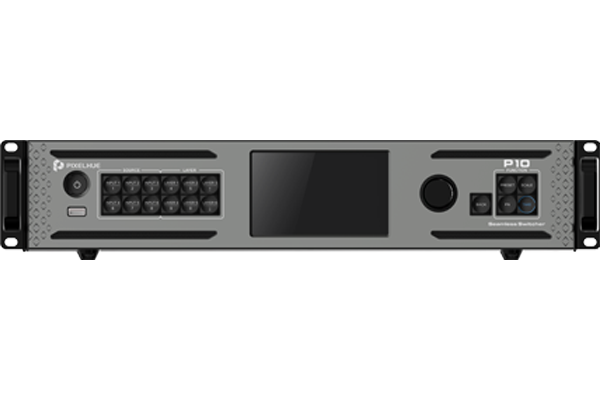
What is the Pixelhue P10?
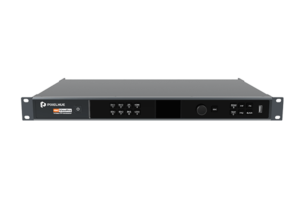
The Pixelhue P10 is a 4K presentation switcher that takes up to six sources, arranges them on one main screen, and cuts from a rehearsed picture to the live one. It takes two rack units.
It suits a show where one operator works through a few laptops and a camera all day and puts the result on one big screen.
You build the next look off air, on a screen only your operator sees, then take it live when you are ready. The whole thing travels at 20.6 kg in its flight case, so the switcher is never the reason you send a second pair of hands to load in.
It does not drive your cabinets. The P10 finishes the picture and hands it to whatever NovaStar controller is already on the wall, and that controller carries on doing exactly what it does today.
Buy one when the show has one main screen, six sources or fewer, and nobody is bringing HDR content.
Pixelhue P10 key features
One person can load it in
2RU, 7.9 kg on its own and 20.6 kg in its flight case. It draws 82 W at most, so it will not change your power calculation, and at 41.9 dB you can leave it in the room with the crew rather than behind a wall.
Your camera reaches the recorder too
Both 12G-SDI inputs come with a loop output beside them. Your camera lands on the switcher and carries straight on to whatever is recording or streaming it, so you have no distribution amp to find room for on a small rig.
Type in the screen you measured
Your screen was quoted in millimeters and the switcher wants pixels, and that conversion is where a layout quietly goes wrong on load-in. Virtual pixel configuration does the arithmetic inside PixelFlow, so the number you type is the screen you actually measured.
Pixelhue P10 specifications
The two rows to read against your own screen plan are the 4K outputs and the 2K outputs. They are different connectors with different ceilings, and which screen goes on which one decides the whole layout.
| Video inputs | 6× 4K: 2× 12G-SDI with loop output, and 4× DP 1.2/HDMI 2.0 where only one connector in a pair carries a source at a time |
|---|---|
| Input handling | 8-bit, 10-bit and 12-bit sources; up to 4096×2160@60Hz or 8192×1080@60Hz; up to 240 Hz; SDI deinterlacing; HDCP 2.2 on HDMI, 1.3 on DP |
| 4K outputs | 2× HDMI 2.0 on connectors 1 and 5; up to 4096×2160@60Hz or 8192×1080@60Hz; maximum width 8192 pixels, maximum height 7680 pixels |
| 2K outputs | 6× HDMI 1.3 on connectors 2, 3, 4, 6, 7 and 8; up to 1920×1080@60Hz or 2048×1080@60Hz; maximum width and height 2048 pixels |
| Fiber outputs | 4× 10G OPT copying the HDMI outputs; up to 10 km on single-mode fiber |
| AUX and Multiviewer | 2× HDMI 1.3 AUX at 1920×1080@60Hz by default and 2048×1152@60Hz maximum; 1× HDMI 1.3 Multiviewer at 1920×1080@60Hz |
| Layers and presets | 6 dual-link as 2 MAIN plus 4 PIP, or 1 MAIN 4K plus 2 PIP 4K; 128 complete and relative presets |
| Dynamic range | SDR. The P10 specification lists no HDR input, output or conversion |
| Screen tools | Smart, luma and chroma key; Cut & Fill; edge blending; LCD bezel compensation; virtual pixel configuration; custom test patterns |
| Sync and control | Genlock in with loop; 5-inch front LCD; U5 and U5 Pro; PixelFlow; Stream Deck with Companion built in |
| Audio | 2× line in and 2× line out on 3.5 mm; PIXELHUE lists the audio function as a future update |
| Power and noise | 100–240V~, 3.0–1.5A, 50/60Hz; 82 W maximum; 41.9 dB(A) typical at 25°C |
| Chassis | 482.6 × 493.0 × 94.6 mm, 2RU, 7.9 kg net; 10.2 kg boxed and 20.6 kg in a flight case; four M5×12 screws |
| Certifications | FCC, IC, CE, RoHS, KC, CB |
Every figure here comes from PIXELHUE’s P10-only specification, V1.7.1, rather than from the datasheet the P10 shares with the P20 and P20-DS.
What the P10 plugs into
Your P10 needs something between it and the LED cabinets, because it has no way to address a receiving card. That job belongs to a NovaStar controller or video processor. An LCD screen or a projector is a different matter — those take HDMI straight off the switcher with nothing in between.
On the fiber side the list is specific. Seven NovaStar controllers accept the P10’s 10G optical output directly: the VX400, VX600 and VX1000, the MCTRL 4K and NovaPro UHD Jr, the MX40 Pro and the H series. On a one-screen job the VX400 or VX600 is usually the right size, and we hold all seven, so one quote covers the pair.
Check your own controller for an optical input before you plan any fiber, because that is the compatibility question that matters here. Pixelhue has been NovaStar’s presentation-switcher brand since 2018 and the optical path is a NovaStar-only path; on another maker’s controller those ports go unused and the show leaves on HDMI.
What fiber buys you is distance. Up to 10 km on single-mode, and no CVT converter anywhere in the middle, because the signal is already optical the moment it leaves the rack.
How many screens can one P10 run?
One at 4K if you want a preview. Two at 4K if you give the preview up. Four or eight at 2K, all of them the same size.
Only one socket is a real output at full 4K; the second large socket copies it, so it gives you a spare rather than a second screen. A second mode promotes that spare into an output of its own, which is where your second 4K picture comes from — at the cost of your rehearsal screen, because in that mode a saved look loads straight to the live output.
| Capacity and mode | Primary connectors | What you end up with |
|---|---|---|
| 4K, switcher mode | 1 only; 5 copies it | One 4K picture, with a spare port carrying the same image |
| 4K, PGM only mode | 1 and 5 | Two 4K pictures at one shared resolution, and no preview |
| SL, switcher mode | 1 to 4; 5 to 8 copy them | Four 2K pictures, all on one resolution |
| SL, PGM only mode | All eight | Eight 2K pictures, all on one resolution |
How much you can stack on those screens follows the same pattern: generous until you ask for 4K. Six half-size layers become three full-size ones — one background and two floating windows — so a 4K roll behind two 4K windows is already the whole box.
Eight ports on the back, one 4K picture in the mode that gives you a preview.
What if your screens are different shapes?
If your screens are different shapes, this is the wrong model, and you want to know that now rather than on site. Every connector in a P10 screen group runs at one resolution.
A 3840×1080 main screen with a 1920×1080 lectern panel beside it is two resolutions, and one P10 group will not hold both of yours. This is not a setting somebody forgot to turn on; it is how the box divides its outputs.
The P20 splits its eight outputs into two resolution pairs, which covers your main screen plus side panels of a different shape. The P10 does not split at all.
You are likely to meet this limit before you meet any of the others.
P10 or P20 — which do you need?
Three things push a show off the P10, and any one of them decides it for you on its own.
HDR is the first. The P10 specification does not mention HDR anywhere — not coming in, not going out, and no way to convert between formats. The P20 accepts HDR on its HDMI sockets and converts between the three formats in use. One HDR source on your rider settles the model choice before you look at anything else.
Audio is the second. Both models have audio sockets marked as a future update, and there is no P10-DS. The P20-DS is the only box in this family that carries sound today, so if your show runs audio through the switcher you skip the P10 entirely.
Screen shapes are the third, for the reason above.
| Specification | P10 | P20 |
|---|---|---|
| 4K inputs | 6 | 12 |
| Output connectors | 2× HDMI 2.0 and 6× HDMI 1.3 | 8× HDMI 2.0 |
| Independent 4K pictures | 1 in switcher mode, 2 in PGM only | 2 in switcher mode, 4 in PGM only |
| Resolution grouping | One resolution across the whole group | Connectors paired 1 with 3 and 5 with 7 |
| Layers | 6 dual-link, or 1 MAIN 4K plus 2 PIP 4K | 12 dual-link (2+10) or 8 dual-link (4+4) |
| HDR | Not in the specification | HDMI 2.0 in and out, with SDR/HDR10/HLG conversion |
| 10G OPT ports | 4 | 8 |
| Chassis and cased weight | 2RU, 7.9 kg net, 20.6 kg cased | 3RU, 10.2 kg net, 25.2 kg cased |
Order the P10 if six sources, one 4K screen and standard-range content cover the show. Order the P20 if any of those three limits applies, or you want the headroom.
The step up costs you a rack unit and 4.6 kg on the truck. It buys you six more sources, six large sockets where you had small ones, and HDR.
P10 datasheet, manual and PixelFlow
Watch which document you take a number from. PIXELHUE publishes one datasheet for the P10, P20 and P20-DS together and one manual covering four switchers and two consoles, so a figure you read there may belong to a sibling. PixelFlow itself costs you nothing to download for Windows or macOS and includes a full offline simulator, so you can build and rehearse your show before the box ships.
Pixelhue P10 FAQ
Can I run two 4K screens off one P10?
Yes, in the second output mode, where both large sockets become real outputs. The two screens have to be the same size and you lose the rehearsal screen, because a saved look in that mode loads straight to the live output.
What is the highest resolution I can get out of the six HDMI 1.3 connectors?
2048×1080@60Hz, or 1920×1080@60Hz on a standard timing, with a 2048-pixel ceiling on both width and height. Anything larger has to leave on connector 1 or connector 5.
Does the P10 handle HDR sources?
No. The P10 specification does not mention HDR anywhere, in or out, and it cannot convert between formats. The P20 is the model in this family that does.
Do I need a NovaStar controller behind the P10?
Yes, for an LED wall. A P10 finishes your picture but has no way to address cabinets; that is what a NovaStar controller or video processor does when it talks to your receiving cards. An LCD or a projector needs nothing extra and takes HDMI straight off the switcher.
Can I run the P10 without a U5 console?
Yes, and on a one-screen show most operators do. The 5-inch panel handles source select and take, and PixelFlow on a laptop covers everything else. A U5 becomes worth its rack space when the cue list gets long enough that hunting through menus costs you a take.
What comes in the box?
The switcher, four cables and the paperwork. PIXELHUE lists the accessories as:
- Power cable, Ethernet cable, HDMI cable and DP cable
- Customer letter and quick start guide
- Safety manual and certificate of approval
The flight case is priced separately — ask for it on the quote if the box is going on the road.
What warranty do I get on the P10?
Three years of serial-tracked manufacturer coverage, supplied through our authorized US channel and shipped from the USA.
How do I get a price on the P10?
Send us the model and the quantity and project pricing comes back within one business day. Put the controller and the case on the same request and the quote covers the whole rack.
Is there volume pricing on more than one P10?
Yes. Give us the count and the pricing moves off the single-unit figure; a fleet going into several rooms is handled as one order rather than one per room.
Can we buy on a purchase order or NET terms?
Yes, for approved buyers. Purchase orders and NET terms, Net 30 included, may be available to schools, government buyers, venues and established integrators.
Reviews
There are no reviews yet.