
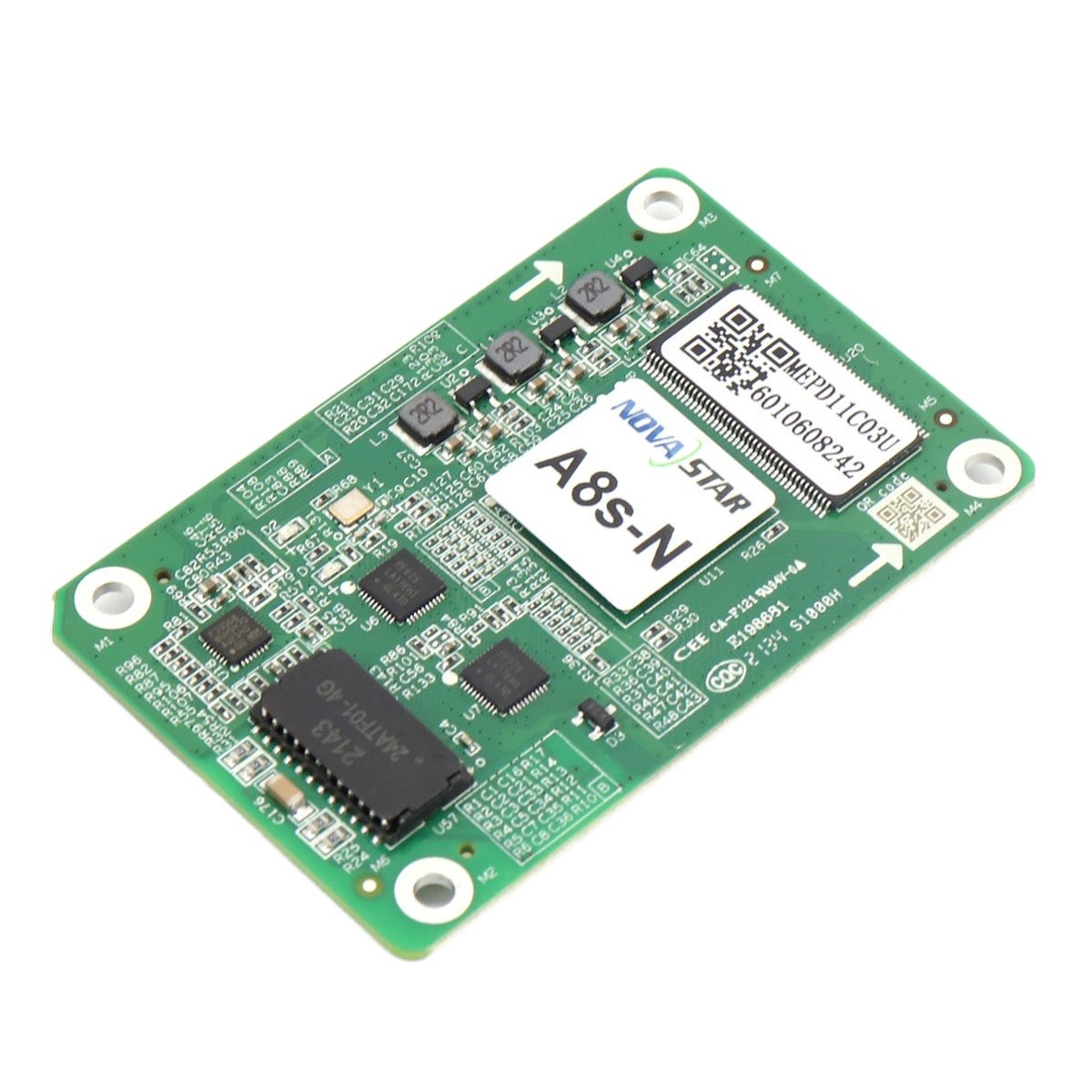
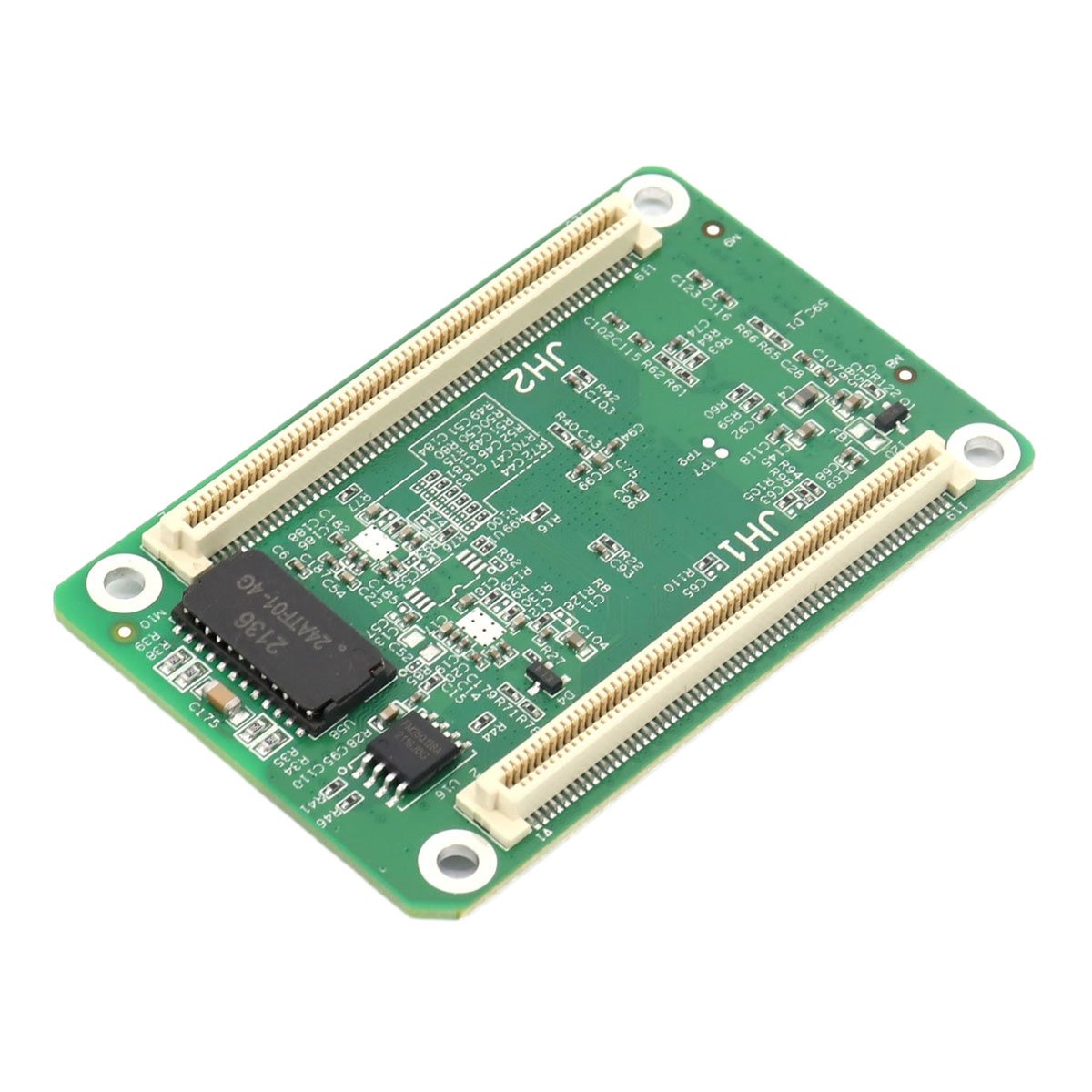
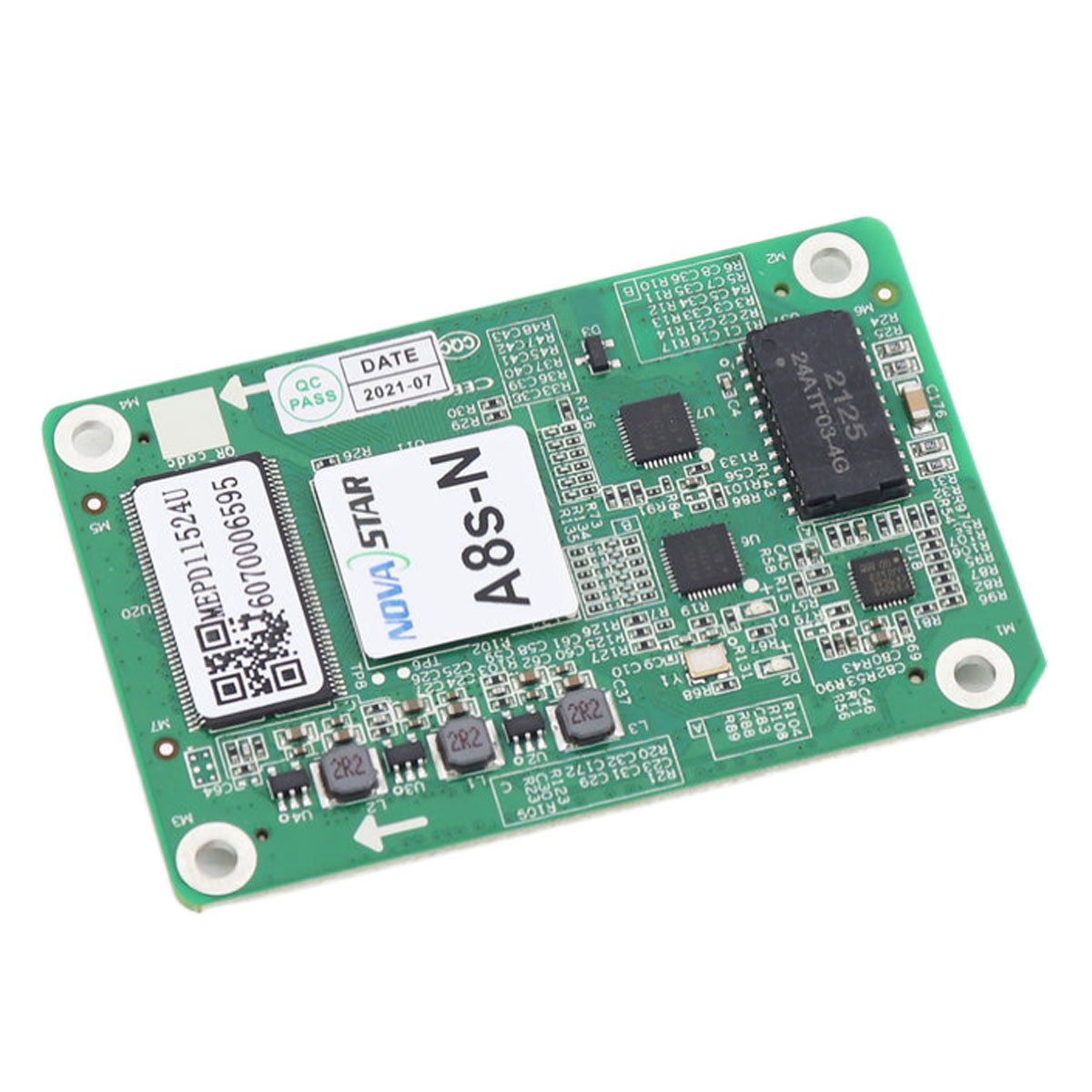
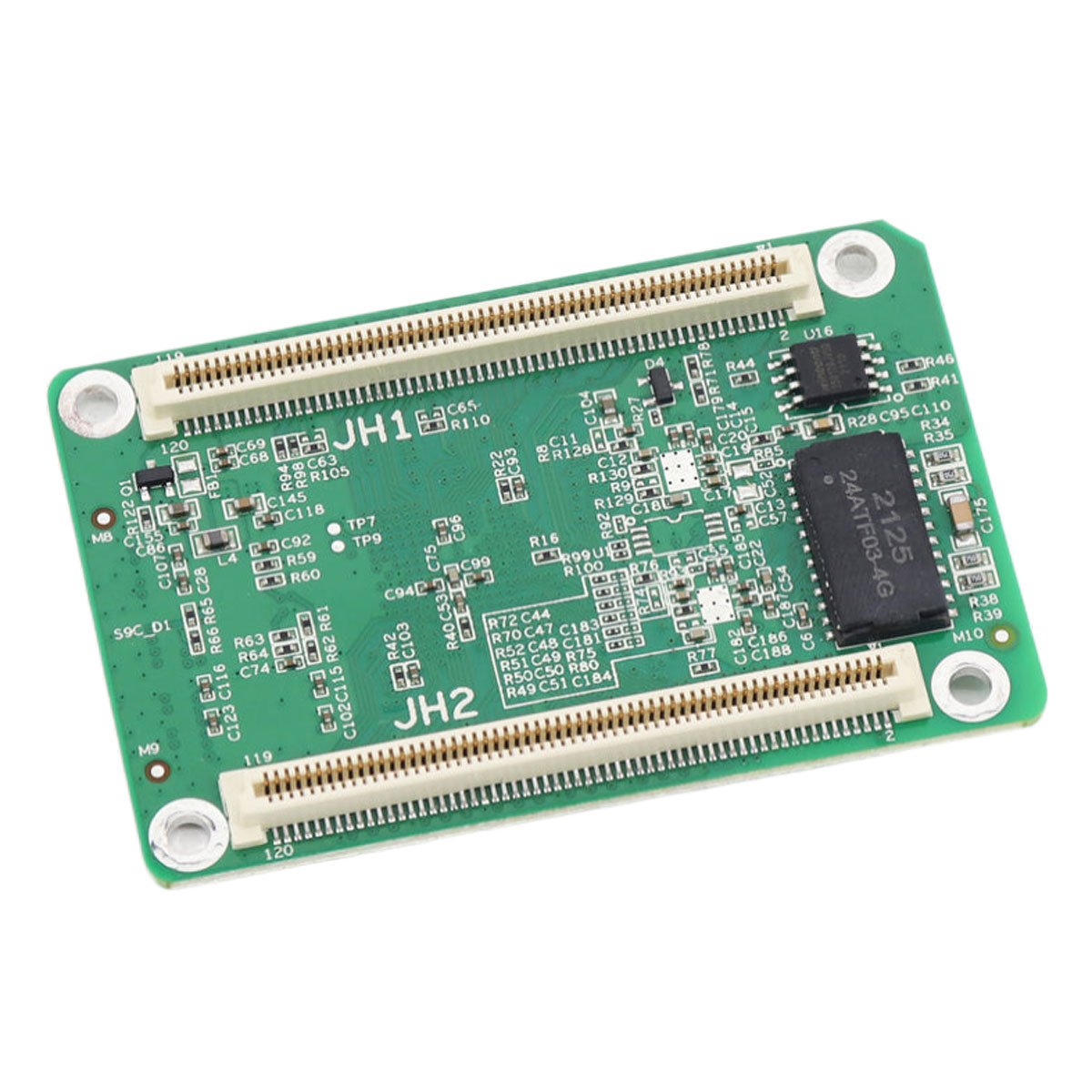
What is the NovaStar A8s-N receiving card?
The NovaStar A8s-N is the receiving card inside a compatible LED cabinet. It receives the image data from the controller and gives each module the pixel data assigned to that cabinet. For a new screen or a replacement, it must match the hub board, module driver IC, scan and saved cabinet configuration.
Its key buying question is bit depth. An A8s-N can carry a 512 by 384 PWM cabinet at 8-bit. At 10-bit or 12-bit, the normal maximum height falls to 256 pixels. There is one useful exception: a 10-bit source running through a COEX controller keeps the taller 384-pixel limit. That difference can change whether one card is enough for a cabinet.
A8s-N key features
Cleaner dark scenes when the module supports it
Dark video can show steps, uneven brightness or a color cast. Image Booster works with a compatible driver IC to improve that low-gray result. The card alone cannot add the effect to every LED module, so the module electronics still need to be checked.
A live-video path with a stated condition
With PWM driver ICs, the documented low-latency path can reduce delay at the receiving-card end to one frame. Some continuous-clock PWM modules need customized firmware. Put that requirement in the cabinet specification before the wall is built, not after a live camera reveals the delay.
Portrait cabinets without rewiring modules
The A8s-N can rotate the display image in 90-degree steps. An image at an arbitrary angle needs SmartLCT and an MCTRL R5 as well, so it should be planned as a complete control system.
Faster fault finding on a long wall
Mapping can show the controller, Ethernet port and receiving-card number on a cabinet. When one cabinet needs attention in a long wall, the technician can identify its location without tracing every signal cable by hand.
NovaStar A8s-N specifications
These are the cabinet-fit and electrical values to check alongside the load table. The table after this one explains how driver type and bit depth change the usable pixel limit.
| Module data | Up to 32 parallel RGB groups or 64 serial groups expandable to 128 |
|---|---|
| Input voltage | DC 3.8 V to 5.5 V; 5.0 V recommended |
| Rated current / power | 0.5 A / 2.5 W |
| Dimensions | 70.0 × 45.0 × 8.1 mm |
| Fitted hub-board spacing | 5.0 mm; NovaStar recommends a 5.0 mm copper pillar |
| Operating environment | −20°C to +70°C; 10% to 90% RH, non-condensing |
| Certifications | RoHS and EMC Class B |
A8s-N 8-bit, 10-bit and 12-bit loading capacity
Do not use one pixel number for every A8s-N cabinet. First identify the module driver IC, then the source bit depth. PWM modules allow a taller cabinet than common-driver modules, while 10-bit and 12-bit normally reduce the maximum height.
| Module driver and source | Documented maximum per A8s-N | What it means for planning |
|---|---|---|
| PWM, 8-bit | 512×384 at 60 Hz | A 512 by 384 cabinet can fit one card after the scan and data groups are checked. |
| PWM, 10/12-bit | 512×256 at 60 Hz | The same 512-wide cabinet may need a second card or a shorter map. |
| Common driver, 8-bit | 384×384 at 60 Hz | Use the smaller 384-wide limit before deciding cabinet card count. |
| Common driver, 10/12-bit | 384×256 at 60 Hz | Higher bit depth cuts the documented height to 256 pixels. |
Pixels are only the first check. The cabinet must still match the A8s-N hub board, scan method, 32 parallel data groups and saved configuration. If the map is close to a listed maximum, leave room for the real module layout instead of treating the largest number as a guarantee.
A8s-N with COEX controllers at 10-bit
With a COEX controller and a 10-bit source, the A8s-N retains 512 by 384 for PWM driver ICs and 384 by 384 for common driver ICs. That can keep a tall 10-bit cabinet within a single card where the normal 10-bit limit would require a second card.
This exception is for 10-bit only. It does not make every controller a COEX controller, and it does not give 12-bit the same capacity. Confirm the controller, source depth, driver IC and cabinet package before changing the card count in a drawing.
For a COEX screen, use VMP with the cabinet files supplied for that system. For a conventional controller path, keep using the working configuration rather than transferring a COEX result unchanged.
A8s-N vs A8s and A8s Pro
An installed A8s-N cabinet is normally best served by another A8s-N with the matching cabinet files. A8s and A8s Pro are alternatives for a verified cabinet design, not automatic upgrades because their names look similar.
| Model | Choose it when | Key check before switching |
|---|---|---|
| A8s-N | The cabinet is built for A8s-N, or its bit-depth and COEX 10-bit rules match the planned system. | Confirm the exact card identity and working cabinet configuration. |
| A8s | The installed cabinet is specifically documented for the original A8s. | Do not treat the similar name as evidence that firmware or cabinet files match. |
| A8s Pro | The cabinet needs up to 40 parallel RGB groups or a 512 by 512 single-card capacity. | Its 70.0 mm outline does not make its hub-board data path an A8s-N match. |
A8s-N datasheet, firmware and software resources
Start with the datasheet when you need the bit-depth and driver-IC limits. Before removing a working A8s-N, use NovaLCT to save its receiving-card program, parameters and cabinet configuration. Then match the full A8s-N label, hub board, power rail, module driver IC, scan and data groups. The -N suffix is part of the model identity, so firmware must match the card PCB and module chips, not merely look close to A8s.
NovaStar A8s-N FAQ
What does the A8s-N receiving card do?
It sits inside a compatible LED cabinet, receives the image data mapped by the controller and sends the correct pixel data to that cabinet’s LED modules.
What is the A8s-N load capacity?
It depends on driver IC and source bit depth. PWM supports up to 512 by 384 at 8-bit and 512 by 256 at 10/12-bit; common driver ICs support up to 384 by 384 at 8-bit and 384 by 256 at 10/12-bit.
Does COEX increase A8s-N capacity at 12-bit?
No. The documented higher capacity exception applies to a 10-bit source with a COEX controller. Do not apply it to 12-bit planning.
Can I mix A8s and A8s-N cards in one wall?
Do not assume so from the similar names. Confirm the exact cabinet interface, firmware, receiving-card parameters and cabinet configuration with the screen manufacturer before mixing models.
Does the A8s-N support HDR?
It supports HDR10 and HLG, but source, controller, driver IC and receiving-card settings must support the same HDR path for the wall to show it correctly.
Does the A8s-N support low latency?
For PWM driver ICs, its documented low-latency path can reduce delay at the receiving-card end to one frame. Some continuous-clock PWM modules need customized firmware.
What should I save before replacing an A8s-N?
Save the working receiving-card program, parameters and cabinet configuration in NovaLCT. Match the exact A8s-N label, hub board, scan, power rail and module data groups before fitting a replacement.
Can the A8s-N rotate a portrait LED display?
It supports 90-degree rotation. Free image rotation at an arbitrary angle needs SmartLCT and an MCTRL R5 controller.
Can I request A8s-N volume pricing or Net 30 terms?
Yes. Send the cabinet count and spare quantity for volume pricing or eligible Net 30 terms. Include the cabinet model if the order is a replacement.
Is the A8s-N covered by a 3-year manufacturer warranty?
Yes. Every A8s-N supplied through our authorized US NovaStar channel carries three years of serial-tracked manufacturer coverage.
Reviews
There are no reviews yet.