
What is the NovaStar MRV210 receiving card family?
The NovaStar MRV210 is a family of four receiving cards for LED cabinets built around the MRV210 platform. Each version receives the part of the image assigned to one cabinet and sends that data to its LED modules through four hub connections.
MRV210-1, -2, -3 and -4 share the same core specification, but their hub connectors use different positions and genders. Choose the exact suffix used by the installed cabinet before checking firmware, capacity or price.
Which MRV210 model fits your LED cabinet?
Read the full model number on the old card, then compare both sides of the board with the cabinet’s mating connection. A card can share the same 256 by 256 rating and still be the wrong spare if its four hub connectors face the wrong side or use the wrong gender.
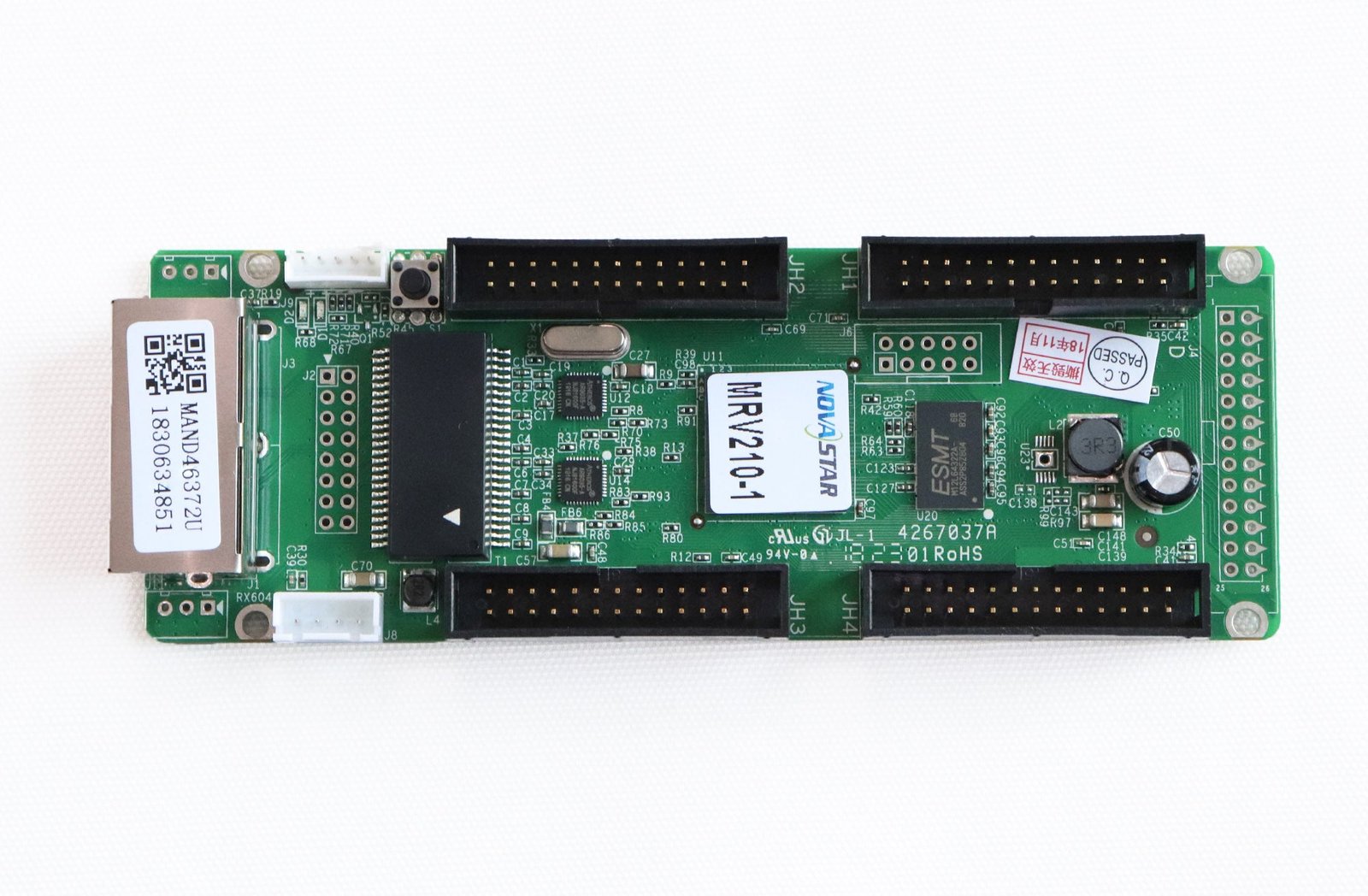
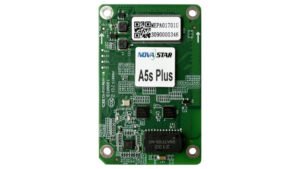
The product image on this family page shows an MRV210-1 as a physical example. Clear photos of both sides of the installed card and the cabinet hub board are still the safest way to confirm the exact version.
MRV210 key features
Choose the board that actually fits the cabinet
The four hubs carry the cabinet’s image data to its modules. Their location and gender are part of the cabinet’s physical design, so the suffix and the mating board matter more than a similar-looking card or a matching capacity number.
Keep the cabinet settings that already work
The card can report temperature and voltage, show operating information on a compatible cabinet LCD, and read back its configuration. Those details make it easier to save a working cabinet’s setup before a card is removed instead of rebuilding its image map from memory.
Avoid a black tile while a signal fault is traced
A stored image can appear at start-up, when video is lost or when an Ethernet cable is disconnected. It will not fix the signal path, but it can keep one cabinet from turning into a black rectangle while the cable, sender or connection is checked.
Use the backup path already wired into the screen
MRV210 supports loop backup when the sending device and cabinets already have both primary and backup signal paths. Replacing one card does not add redundancy, but the card can keep using the protection designed into a properly wired screen.
NovaStar MRV210 specifications
Use these values to rule out an obvious mismatch. A complete replacement match also needs the right suffix, module scan and saved cabinet configuration.
| Maximum load | Up to 256 × 256 pixels per receiving card |
|---|---|
| Hub connections | Four hub connectors |
| Parallel data modes | 16 groups of RGBR’, 20 groups of RGB, or 24 groups of RGB depending on scan mode |
| Serial data | Up to 64 groups |
| Input / power | DC 3.3–5.5 V; 0.5 A rated current; 2.5 W rated power |
| Board size | 138.9 × 47.9 × 17.5 mm |
MRV210 scan modes and module data groups
The 256 by 256 figure is a whole-card ceiling, not a promise for every module layout. Different module scans use different data arrangements, so the card and module must use the same pattern before the cabinet can show the image in the right order.
| MRV210 parallel mode | Documented scan use | What to verify in the cabinet |
|---|---|---|
| 16 groups of RGBR’ | Up to 1/32 scan | Confirm the module uses this higher-scan data arrangement. |
| 20 groups of RGB | Up to 1/16 scan | Confirm the module’s Ctrl signal and the existing cabinet configuration. |
| 24 groups of RGB | Up to 1/4 scan | Check the lower-scan module wiring rather than selecting from pixel count alone. |
A wall can look scrambled, striped or partly lit when a fitted card has the wrong scan mode or a configuration from a different module. Save the working cabinet configuration whenever possible. If there is no known-good file, confirm the module driver and scan details with the cabinet manufacturer before creating a new configuration.
Replacing an MRV210 without losing the cabinet configuration
Before a working MRV210 is removed, use NovaLCT to read back and save its receiving-card configuration. That file records the cabinet’s scan, wiring and pixel map. Save the full suffix and the working firmware version alongside it.
The two files do different jobs. The cabinet configuration tells the card how this cabinet is built; firmware is the program running on the card and must suit its hardware and module electronics. Firmware cannot replace a cabinet file, and a cabinet file cannot make a different MRV210 suffix fit.
After fitting an exact match, test one cabinet before replacing more cards. Check the module map, colors and image, then confirm voltage and the running indicator. A normal green running light flashes once each second when Ethernet and video input are both present, giving the service team a useful starting point if something is still wrong.
MRV210 datasheet, firmware and NovaLCT downloads
Start with the datasheet to confirm the four-hub family, board size and supported data modes. Use NovaLCT to read and save the working cabinet configuration before the card is removed. NovaStar lists an MRV210 V4.6.0.0 firmware entry in its official receiving-card download center; use it only after the exact board, module driver IC and known-good configuration have been checked.
NovaStar MRV210 FAQ
What does the MRV210 receiving card do?
It sits inside an LED cabinet, receives the image data sent to that cabinet and sends the assigned pixel data to the modules through the matching hub connections.
Does 256 by 256 apply to each MRV210 hub connector?
No. It is the documented maximum for the receiving card as a whole. The four hub connectors share that card-wide load according to the cabinet’s module layout.
Can MRV210-1 replace MRV210-2?
Not automatically. The electronics are related, but -1 uses a top-side male connector and -2 uses a bottom-side male connector. Match the exact connector position and the cabinet’s mating board before ordering.
What is the difference between MRV210-3 and MRV210-4?
Both use female hub connectors. The -3 places them on the top side of the board, while the -4 places them on the bottom side. The cabinet clearance and mating arrangement decide which one fits.
Why does a replacement MRV210 show a scrambled image?
The card may have the wrong suffix, scan mode or cabinet configuration. Confirm the exact physical board first, then restore the configuration from a known-good cabinet before changing firmware.
What should I save before replacing an MRV210?
Save the receiving-card configuration in NovaLCT, note the board suffix and keep a record of the working firmware version. The configuration preserves the cabinet map; it is separate from firmware.
Does MRV210 support loop backup?
Yes, when the screen and sending device are wired as a primary-and-backup loop. A replacement card alone cannot create that signal path.
Can I use MRV210 with a newer COEX or VMP system?
Do not assume compatibility from the NovaStar brand alone. MRV210 is a legacy receiving-card family, so confirm the exact controller and receiving-card support matrix before changing the control system.
Can I request MRV210 volume pricing, Net 30 terms or exact-suffix help?
Yes. Send photos of both sides of the installed card, the cabinet’s mating board, the required spare quantity and any saved configuration file. We can help identify the correct suffix, confirm project pricing and review eligible Net 30 terms before you place a larger order.
How is MRV210 warranty coverage handled?
MRV210 cards supplied through our authorized US NovaStar channel include three years of serial-tracked manufacturer coverage. Keep the serial record together with the cabinet configuration for future service.
Reviews
There are no reviews yet.