
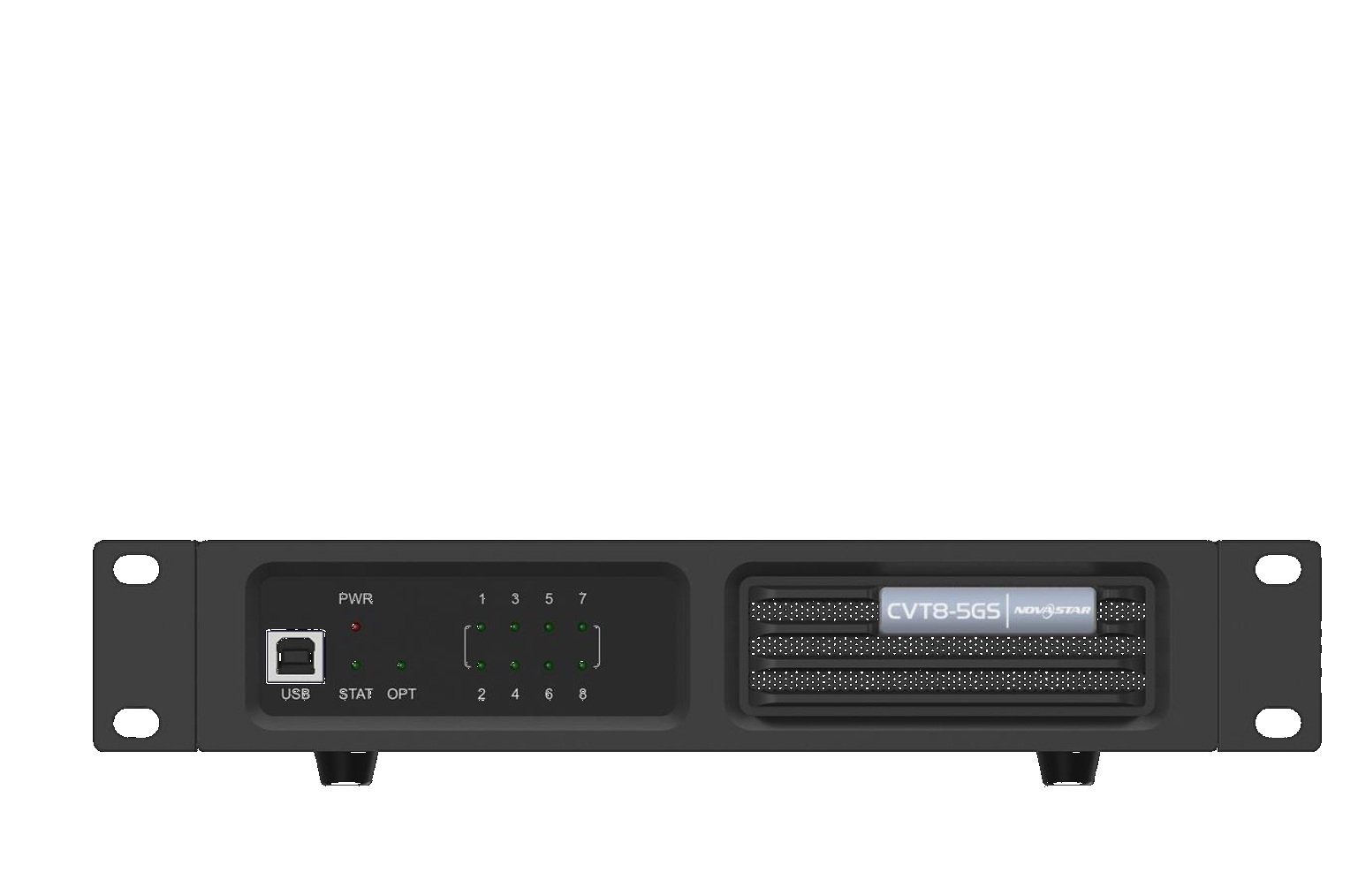
What is the NovaStar CVT8-5GS?
If your 5G control room sits outside the building the screen is in, the NovaStar CVT8-5GS is the single-mode converter that closes that gap. One 40G optical link travels up to 10 km and arrives as eight 5G BaseT Ethernet ports, which makes it the only 5G converter that can leave a building.
You land it on ordinary LC single-mode fiber, the same 9/125 µm OS1 or OS2 a 1G route already runs on. The multimode version will not do that: the CVT8-5GM needs 8-core MPO, so if your site is wired with LC, this is the one model that lets you move to 5G on the fiber you already own.
Your fiber is only half the question, because the rest of the system still has to be 5G. A CVT8-5GS sits behind a 40G fiber output card and in front of XA50 Pro or CA50E receiving cards, and it will not drive 1G cabinets whatever the fiber does.
CVT8-5GS key features
The only 5G reach worth calling distance
Your 5G system normally stops at the walls of the room it was installed in, because the multimode build reaches 100 m on OM3 and a copper run already does that. The CVT8-5GS covers up to 10 km at 1310 nm on single-mode fiber. Your control room can be in another building and the wall still runs at 5G.
Back on LC, so an existing route survives the upgrade
You do not have to re-pull fiber between the buildings, which is the line item that quietly kills an upgrade. MPO trunking is rarely what a campus was wired with anyway. This model takes 9/125 µm OS1 or OS2 twin-core on LC connectors, exactly what your CVT10-S or CVT4K-S link runs on. The glass in the ground stays put.
One optical port, at the far end of a long route
You get one 40G optical port here and no standby behind it, where the CVT10 and CVT4K families keep a spare for a second duct. On a 10 km route that matters more, not less: a cut means an excavator and a closed road, not a swapped cable. Protection has to be a second converter; the chassis will not give you one.
33 W in a cabinet nobody opens
Your remote equipment rooms and roadside enclosures run hotter than the rack the kit was specified from, and this is the least tolerant chassis in the fiber family. It draws 33 W and stops at +45°C with humidity to 80%, non-condensing. So the number you want first is what your enclosure reaches in summer, not what the rack does.
NovaStar CVT8-5GS specifications
You only need two rows of this table to make the call: the fiber row tells you whether your existing route can be reused, and the operating environment row whether your enclosure can hold the unit.
| Ethernet ports | 8 × 5G BaseT, each up to 5 Gbit/s, on CAT6 cable up to 100 meters |
|---|---|
| Optical port | 1 × 40G, hot-swappable, with the module shipped pre-installed |
| Optical module | 40 Gbit/s at 1310 nm |
| Fiber to order | OS1 or OS2 single-mode twin-core, 9/125 µm, LC connectors, insertion loss ≤ 0.3 dB, return loss ≥ 45 dB |
| Optical distance | 10 km |
| Backup optical path | None. There is one optical port |
| Control port | 1 × type-B USB, for program upgrades from NovaLCT V5.4.0 or later. It is not a cascade port |
| Power | 100–240 V~, 50/60 Hz, 1.5 A, PowerCON. Do not connect or disconnect it under power |
| Rated power consumption | 33 W |
| Operating environment | −20°C to +45°C, 10% to 80% RH, non-condensing |
| Dimensions and net weight | 254.3 × 50.6 × 290.0 mm, 2.26 kg, half-1U wide |
| Certifications | RoHS, CE, FCC, IC, UL, CB; FCC Class A |
| Supplied in the box | Power cord, USB cable, two 40G optical modules with one intended for the controller, supporting brackets A and B, connecting piece, screws |
You get two 40G modules in the box, which is worth noting on the order. The second one is intended for your controller end, so a first purchase does not stall while you wait on a separate optic.
Moving a 1G single-mode site to 5G
Your fiber survives the change and almost nothing else does. Treat the table below as a parts list rather than as an upgrade, and your budget stays honest.
| Part of the system | 1G build | 5G build | Carried over? |
|---|---|---|---|
| Output card | MX_4 10G Fiber Output Card | MX_1x40G Fiber Output Card | No |
| Fiber converter | CVT10-S | CVT8-5GS | No |
| Receiving cards | 1G cards such as the A10s Pro | XA50 Pro or CA50E | No, and this is every cabinet |
| Single-mode fiber and LC terminations | OS1 or OS2, LC twin-core | OS1 or OS2, LC twin-core | Yes |
| Copper legs at the screen | Cat6 | Cat6, up to 100 m | Yes |
The last column is easiest to read from the bottom up. The two rows you carry over are the ones with digging and labour attached — the civils, in trade language — which is why an existing single-mode route is what makes 5G worth costing at all.
Price the receiving cards before anything else. Every cabinet on your wall changes, and that line decides your project long before the converter does.
Where a CVT8-5GS is used on an LED display system
You reach for this converter when your 5G system will not fit inside one building. Each case below needs the bandwidth of the 5G architecture and a route measured in kilometres.
Cost your receiving cards before the converter. Moving your wall to 5G changes every cabinet on it, and that line decides your project long before this chassis does.
If your whole 5G system sits in one building, the CVT8-5GM costs you less — as long as its 100 m on OM3 genuinely covers your route, and the fiber is MPO rather than LC.
CVT8-5GS, CVT8-5GM or CVT10-S
Your first question is what your cabinets run, because two of these are 5G and one is 1G. After that it comes down to distance and connector type.
| CVT8-5GS | CVT8-5GM | CVT10-S | |
|---|---|---|---|
| Receiving cards | 5G only | 5G only | 1G |
| Ethernet ports | 8 at 5G | 8 at 5G | 10 at 1G |
| Optical | 1 × 40G, LC single-mode | 1 × 40G, MPO 8-core | 2 × 10G, LC single-mode |
| Reach | 10 km | 100 m on OM3, 150 m on OM4 | 10 km |
| Backup optical path | None | None | OPT2 |
| Price | $4,029 | $3,277 | $1,150 |
- Order the CVT8-5GS when the system is 5G and the route is longer than a building, or when the existing fiber is single-mode on LC.
- Order the CVT8-5GM when the 5G equipment all sits inside one venue and an MPO trunk is being installed for it. At $3,277 against $4,029 it saves money only where its 100 m reach is genuinely enough.
- Order the CVT10-S when the cabinets run 1G receiving cards. It is not a slower 5G converter; it belongs to the other architecture, and at $1,150 it is a quarter of the price.
NovaStar CVT8-5GS manual, datasheet and NovaLCT software
You can swap a remote CVT8-5GS without saving anything off the old one, because nothing about the screen is stored in it. The specification sheet carries the single-mode fiber grades and the temperature limits, and NovaLCT V5.4.0 or later handles a program upgrade over the USB port.
NovaStar CVT8-5GS FAQ
How far will a CVT8-5GS reach?
Your CVT8-5GS will reach 10 km on OS1 or OS2 single-mode fiber at 1310 nm. That is the longest reach you can get in NovaStar’s 5G architecture.
Can it reuse the fiber from a 1G single-mode link?
Yes, you can reuse the single-mode fiber from a 1G link. It terminates on 9/125 µm OS1 or OS2 twin-core with LC connectors, the same specification your CVT10-S or CVT4K-S route already uses.
Will it work with 1G receiving cards?
No, your 1G receiving cards will not work with it. The 5G solution pairs a 40G fiber output card with XA50 Pro or CA50E receiving cards, so a wall of 1G cabinets takes a CVT10-S instead.
What has to change to move a 1G site to 5G?
To move your 1G site to 5G you change the output card, the converter and every receiving card in the wall. Your single-mode fiber, its LC ends and the Cat6 legs at the screen all carry over.
Is there a backup optical port?
No, there is no backup optical port. One 40G optical port serves all eight Ethernet ports, so a fiber fault stops your whole link, and redundancy has to come from a second route and a second converter.
Are optical modules included?
Yes, two optical modules are included, with the second intended for your controller end. That is enough to complete a link from one purchase where the output card is already fitted.
What is the difference from the CVT8-5GM?
The difference from the CVT8-5GM is optics and connector. This model gives you 1310 nm single-mode on LC for 10 km; the CVT8-5GM is 850 nm multi-mode on 8-core MPO for 100 m on OM3.
Can it sit in an unmanned remote cabinet?
It can sit in an unmanned remote cabinet only within −20°C to +45°C and 80% RH, non-condensing. It draws 33 W, which is enough to matter in a small sealed enclosure in summer.
What warranty covers a CVT8-5GS?
Your CVT8-5GS warranty is three years of serial-tracked manufacturer coverage, because these units come through our authorized US NovaStar channel.
Can I get volume pricing or Net 30 terms?
Yes, you can ask for volume pricing — send us the model and the quantity you need. Purchase orders and Net 30 terms may be available for approved schools, government buyers, venues and established integrators.
How do I order a CVT8-5GS?
You order a CVT8-5GS at the listed price, which is per chassis. If you plan a 5G wall from scratch, get the receiving cards quoted too, because they drive the total. Orders placed before 3 PM ET on in-stock items ship the same business day. Contact us to confirm current availability.
Reviews
There are no reviews yet.