
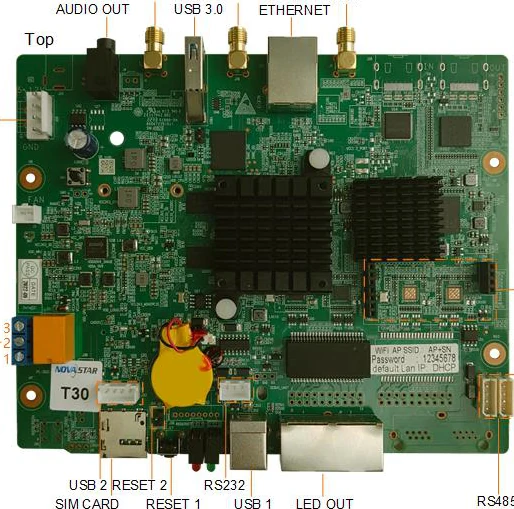
What is the NovaStar T30?
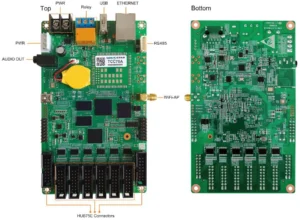
The NovaStar T30 is a Taurus multimedia player supplied as a bare circuit board rather than a finished box. It stores your content, plays it on a schedule, and drives up to 1,300,000 pixels of LED screen. You supply the enclosure it lives in. The board is 165.0 mm by 146.4 mm by 21.2 mm and weighs 179.7 g.
You would specify one when the player has to disappear inside the product. Cabinet makers and sign manufacturers use the board for that reason. No second box to mount, no second mains lead, and nothing on the outside for a customer to unplug.
Everything else about it matches the boxed models. The same software publishes to it, the same schedules run on it, and the same 32 GB of internal storage keeps the screen playing when nothing is connected.
NovaStar T30 key features
It runs off a rail your cabinet already has
The T30 accepts anything from 5 V to 12 V DC. That range is wide enough that it will usually share the supply already feeding your modules. No separate power brick, no second inlet in the housing.
Budget 25 W for it even though it never draws more than 18 W, so the board is not competing with the LED load at the moment it starts up.
Controls you can bring out to your own panel
Two things on this board exist so you can build them into a housing. A second reset connector lets you wire a factory-reset button through to a surface a technician can reach, and the Wi-Fi and antenna leads run out to connectors you place yourself.
You end up with a product that looks like one device rather than a player someone bolted inside a cabinet.
Sensors go straight onto the board
Two sensor connectors take a light sensor such as the NS060-5A or a temperature and humidity sensor, so automatic brightness needs no extra card in your design.
On a sealed sign that nobody opens for a year, the temperature reading is the part you will be glad of.
NovaStar T30 specifications
Read the first three rows against your screen and the middle rows against your housing; those are the two checks that decide whether this board fits your product.
| Pixel capacity | 1,300,000 pixels; maximum 4096 wide and 4096 high |
|---|---|
| Long thin screens | Up to 23,040 pixels wide and 4096 high, inside the same total |
| Screen outputs | 2x Gigabit RJ45, both live by default, or one main and one spare |
| Video input | None; the T30 plays only what is stored on it |
| Board size | 165.0 mm × 146.4 mm × 21.2 mm; 179.7 g |
| Power in | DC 5 V to 12 V; 18 W maximum draw, 25 W supply recommended |
| Relay contact | 3-pin dry contact, maximum DC 30 V and 3 A; supplies no voltage of its own |
| Sensor connectors | 2x RS485, for a light sensor or a temperature and humidity sensor |
| Radio modules | On-board 4G slot and RF module connector; neither module is included |
| Processor and memory | Quad-core ARM A55 at 1.8 GHz, 1 GB RAM, Android 11 |
| Internal storage | 32 GB, plus a USB 3.0 socket for more |
| Video it can play at once | 1x 4K, or 2x 1080p, or 5x 720p, or 6x 480p, or 6x 360p |
| Operating range | −20°C to +60°C, 0% to 80% RH, non-condensing |
| Approvals listed | MIC, FCC, IC, CE |
| In the box | Wireless antenna, power connector, 2 antenna pigtails, QR card, certificate |
Figures come from NovaStar’s T30 Multimedia Player Specifications V1.3.4, dated 31 July 2026. That revision raised the pixel figure from 650,000, so older listings for this board understate it by half.
Designing a T30 into your cabinet
Plan for a board 165.0 mm by 146.4 mm with 21.2 mm of height above the mounting plane, and leave working room at both ends where the connectors sit. The tolerance NovaStar publishes on those figures is 0.3 mm.
Ask NovaStar for the precision structural drawing before you cut anything. The datasheet drawing is dimensioned for planning; the higher-precision version is what you want if you are making a mould or drilling mounting holes in a production run.
Nothing on the board is weather-rated, so your housing does all the work. Keep the air around it between −20°C and +60°C at up to 80% humidity. A sealed sign in summer sun runs far hotter inside than the shade temperature suggests.
Approvals are worth checking early. NovaStar lists MIC, FCC, IC and CE against this board. Where your finished product needs a mark the board does not carry, that certification lands on you as its manufacturer.
What the on-board relay can switch
A three-pin relay sits on the T30, and it is a dry contact. It opens and closes a circuit you provide, and supplies no voltage of its own. Its ceiling is 30 V DC at 3 A, and you drive it from the power page of the same software you publish content with.
That is enough to switch a low-voltage circuit directly, and it is nowhere near enough for the screen’s own supply. Three amps at 12 V is 36 watts; an LED cabinet draws that many times over.
So NovaStar publishes a wiring method rather than letting you put mains through the contact. Its diagram has the relay pins drive the control side of a solid-state relay, which takes its own weak-current supply of 3 V to 30 V, and that relay carries the live wire on its own strong-current terminals.
Wire it one of two ways. A plain on-off circuit uses two of the three pins. Use all three and you get a changeover contact, where one side is made as the other breaks. That is what you want when something has to be held firmly off, not merely left unswitched.
This is the feature that most often decides between a board and a box. The boxed players in the family have no relay, so scheduled power switching there needs a separate multifunction card.
How much screen it drives, and why there is no video input
One T30 drives 1,300,000 pixels across its two Gigabit outputs, with neither side of the screen passing 4096 pixels. A long thin display is the exception and may run to 23,040 pixels wide inside the same total.
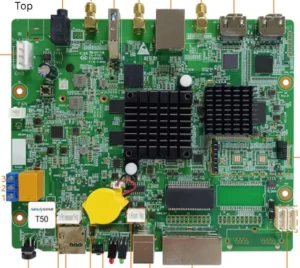
Everything it shows comes from its own storage. There is no HDMI socket on this board, which is the single line separating it from the T50, and it cannot be added later.
For products that play prepared content, that is not a limitation, it is one less connector to bring out through your housing. For anything that might one day take a camera or a laptop, it decides the model for you.
One setting catches people out after the cabinets are mapped: the picture the player generates internally must be larger than the screen resolution you configured, or a strip of the display never lights.
T30, T50 or T60 — choosing the board
All three boards are the same size, the same thickness and the same weight class, so they drop into the same housing. What changes is capacity, cable routes and whether a live source can be plugged in.
| Board | T30 · T50 · T60 |
|---|---|
| Pixel capacity | 1,300,000 · 1,300,000 · 2,300,000 |
| Screen outputs | 2 · 2 · 4 |
| HDMI in and loop out | no · yes · yes |
| Board size | 165.0 mm × 146.4 mm × 21.2 mm on all three |
| Weight | 179.7 g · 184.5 g · 197.6 g |
| Price | $259 · $365 · quoted per project |
Order the T30 if your product plays prepared content only — it is the cheapest of the three and gives up nothing you would use.
Order the T50 if a live source has to reach the screen, and the T60 once the screen passes 1,300,000 pixels or needs four cable routes. Since all three share a footprint, a housing designed for one takes any of them, which is worth doing if the same product will be sold in several sizes.
T30 datasheet, ViPlex Express and firmware
Set the board up with ViPlex Express on a Windows PC, which is also where your cabinet map, brightness curve and relay schedule live. Keep that map: replacing a board in a finished product is quick, rebuilding the map through an access panel is not.
Firmware updates run over the internet in one step on anything newer than V2.3.0. A board still on older software has to reach V2.3.0 from a local file first.
NovaStar T30 FAQ
Does the T30 come in a case?
No. It is supplied as a bare board with an antenna, a power connector and two antenna pigtails. The boxed equivalent is the TB30, which has the same electronics in a mains-powered chassis.
Is the T30 650,000 pixels or 1,300,000?
1,300,000 on the current datasheet. NovaStar raised the figure in revision V1.3.4 of 31 July 2026; the lower number that most listings still carry comes from the January 2026 revision.
What voltage does the T30 need?
Anything between 5 V and 12 V DC, drawing at most 18 W. NovaStar recommends sizing the supply at 25 W.
Can the relay switch the screen’s power directly?
No. It is a dry contact rated at 30 V DC and 3 A, and it supplies no voltage itself. NovaStar advises against putting mains through it and publishes the alternative: the relay pins drive a solid-state relay with its own 3 V to 30 V supply, and that device carries the live wire.
Can I add an HDMI input later?
No. There is no video input on this board and none can be fitted. The T50 is the same board with an HDMI input and a loop-through output.
Does it take a 4G module?
Yes, there is a module slot and an antenna connector on the board, but the module itself is bought separately. The player prefers a wired connection, then wireless, then mobile data.
Where do I get mounting hole positions?
Ask NovaStar for the high-precision structural drawing. The dimensioned drawing in the datasheet is for planning; the precision version is what you use for moulds or a production drilling jig.
Is the T30 UL listed?
No. NovaStar lists MIC, FCC, IC and CE against this board. If your finished product needs a mark the board does not carry, that certification is yours to obtain as its manufacturer.
What warranty covers a T30?
Three years of serial-tracked manufacturer coverage, because these boards come through our authorized US NovaStar channel.
Can I get volume pricing or Net 30 terms?
Yes, and boards are the part of this range most often bought in quantity. Send the model and the count for volume pricing. Purchase orders and Net 30 terms may be available for approved schools, government buyers, venues and established integrators.
How do I order a T30?
Pricing here is per board. Orders placed before 3 PM ET on in-stock items ship the same business day from Florida. Contact us to confirm current availability.
Reviews
There are no reviews yet.