
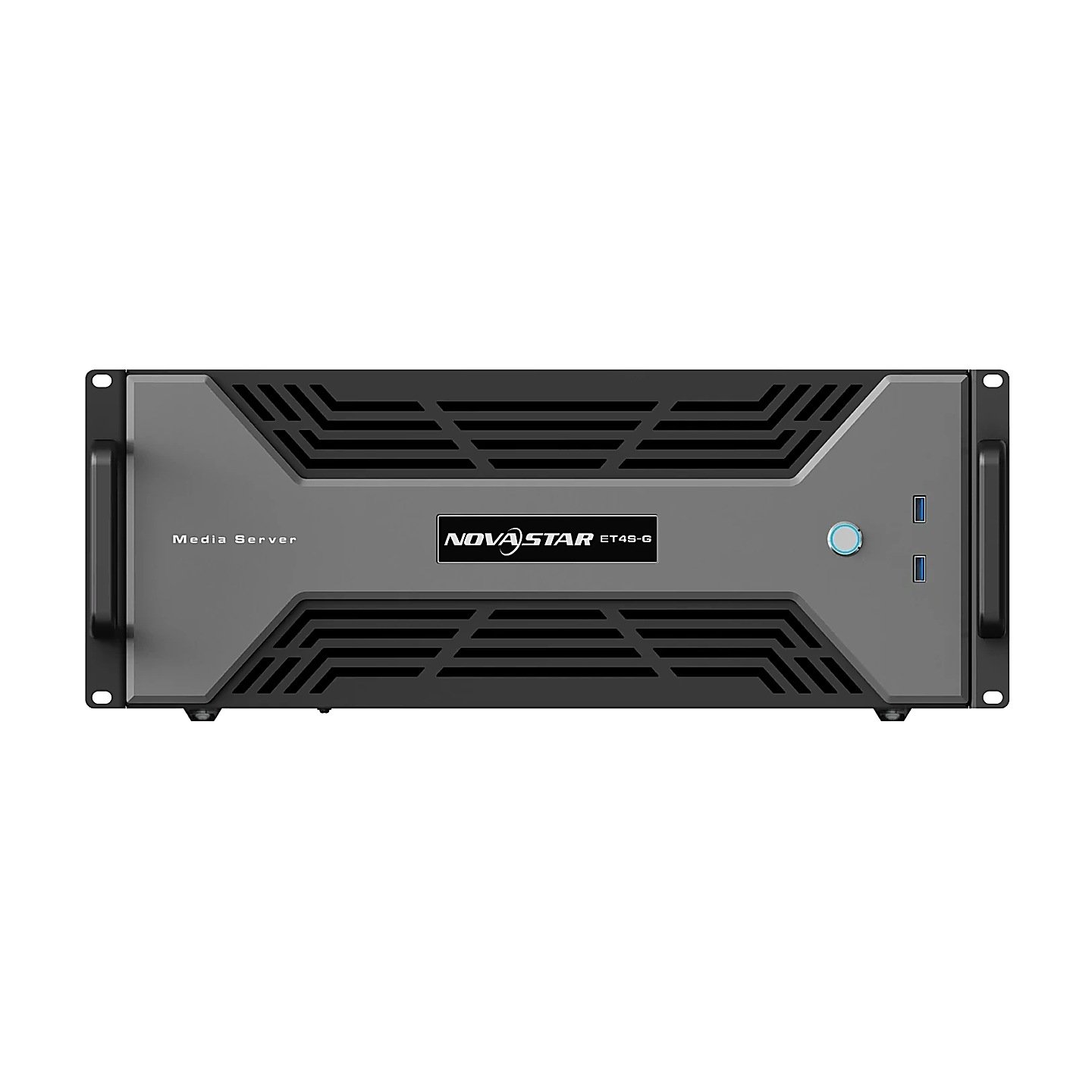
What is the NovaStar ET4S-G (P2)?
If your content is cut as 4K films and nothing on the job has to be genlocked, the NovaStar ET4S-G (P2) is the build of NovaStar’s four-output media server that fits. It is the ET4S-G chassis with one P2000 graphics card fitted, running Kompass FX3 and mixing up to twelve layers over four DP 1.4 connectors.
The suffix is what you are actually choosing. NovaStar sells this chassis bare, as this P2 build and as an A4 build, and the card inside decides how many of your films decode at once, how wide your mosaic can go, and whether you can ever add a sync card.
You want this build for a fixed installation whose content is cut as 4K films rather than a single 8K master: an exhibition hall, a banquet room, a themed attraction, a stage set running pre-produced media on a timeline.
As with every media server, your picture stops at DisplayPort. A sending card or video processor takes it from there to the cabinets.
What the P2000 graphics card decides
Three things, and all of them land on your quote rather than in the software. NovaStar documents the P2000 for one 8K×4K@30fps film or three 4K×2K@60fps SDR films decoded in hardware, a four-connector mosaic up to 8192 pixels, and 5 GB of GDDR5X memory on a 160-bit bus.
Three 4K films at 60 frames is the number you will use. If your design is a centre screen with two flanking panels, each fed its own 4K film, that is exactly what this card is documented to carry, and your twelve mixing layers sit on top of them.
An 8K master is where it stops for you. The P2000 is rated for 8K×4K at 30 frames, so a 60-frame 8K film has to be re-cut into smaller pieces or your job needs the A4 build.
The sync card is the one that catches people. NovaStar states that it works with the HPGA4000 and HPGA4500 Ada cards, which leaves the P2000 with no route to frame lock or external sync. If genlock or a second synchronized server is anywhere in your brief, this is not your build.
ET4S-G (P2) key features
Twelve mixing layers
A themed room usually wants more elements than your editor wants to bake into one file. Twelve layers and one audio track run together, each with its own size and priority, so your film, the OSD, the caption and the live source stay separately controllable to the end of the job.
Output splitting and rotation
Fabricators build screens in shapes your rectangular timeline never fits. You split, reassemble and rotate the outputs across up to 64 partitions each, which is how a stepped wall or a run of angled portrait fins takes its slice of one canvas.
Frame sequence playback
Some of your content arrives as numbered stills rather than a video file, usually from a render farm or a scanning rig. You play bmp, tiff, tga, jpg and png sequences directly, so nobody transcodes a render just to get it on the wall.
Separate system and media drives
A media drive that fills up while Windows sits on the same partition is a support call waiting for you. This chassis ships with a 250 GB system SSD and a separate 1 TB media SSD, and NovaStar lists further 1 TB or 4 TB drives as an option.
NovaStar ET4S-G (P2) specifications
These are the figures that settle your rack, your power schedule and your content brief.
| Graphics card fitted | 1× P2000, 5 GB GDDR5X, 160-bit |
|---|---|
| Hardware decoding | 1× 8K×4K@30fps, or 3× 4K×2K@60fps SDR |
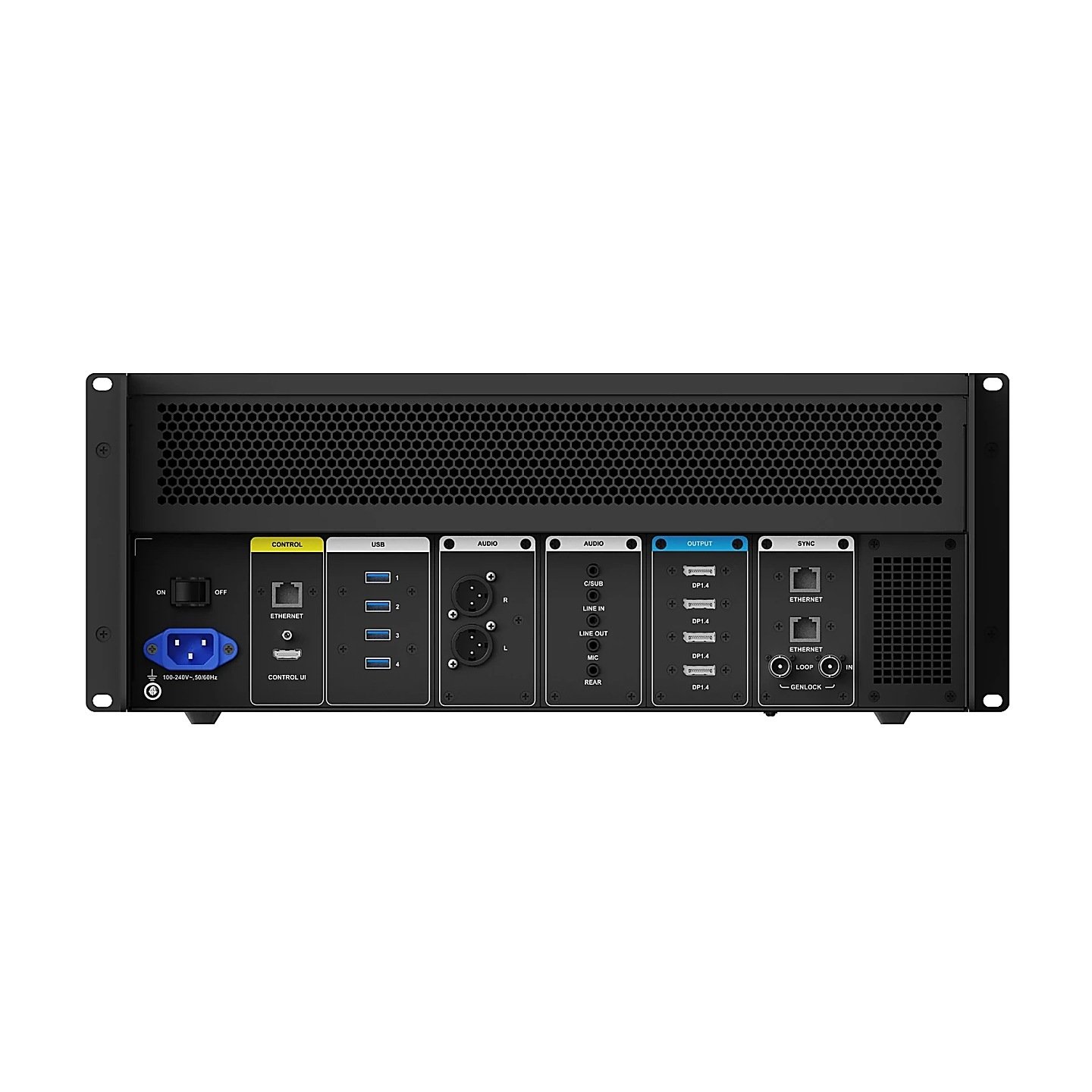
| Video outputs | 4× DP 1.4, each up to 5120×2880@60Hz |
| Mosaic limit with this card | 8192 pixels of width or height across the four connectors |
| Playback | 12 mixing layers and 1 audio track; up to 64 partitions per output |
| Sync card | Not supported with the P2000; NovaStar pairs it with the HPGA cards only |
| Processor and memory | 12th-generation Intel Core; 32 GB DDR5 on a server-grade board |
| Storage | 250 GB system SSD plus a 1 TB media SSD; 1 TB or 4 TB drives optional |
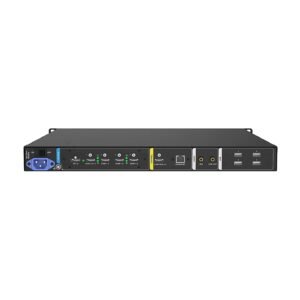
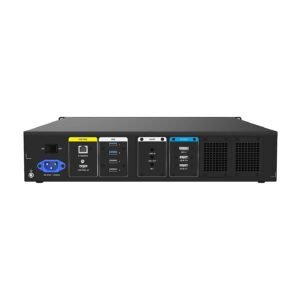
| Control and network | 1× RJ45 at 2.5 Gb; HDMI CONTROL UI at 2K×1K@60Hz; UDP or TCP/IP remote control; VICP |
| Audio | XLR left and right outputs; 3.5 mm centre/subwoofer, line in, line out, mic and rear |
| Timecode | External LTC and MTC inputs |
| Software | Kompass FX3 with licensing dongle, on Windows 10 Enterprise LTSC |
| Power | 100–240V~, 47–63Hz; 750 W supply; 500 W maximum consumption |
| Environment | 0°C to +40°C operating; −10°C to +60°C storage; non-condensing |
| Dimensions and weight | 482.6 × 183.5 × 642.0 mm, 17 kg |
| Certifications | CE, FCC, IC, CB, KC, RoHS |
Read the height and depth rows together before your rack drawing goes out: 183.5 mm needs a five-unit opening, and 642.0 mm of chassis wants a deep cabinet with room behind it for four DP tails.
Four DP 1.4 outputs and the 8192-pixel mosaic ceiling
You get four connectors, each good for 5120×2880@60Hz, joined into one mosaic that this build caps at 8192 pixels along its long edge. The chassis section of the datasheet quotes 16384; the P2000 entry in the same document quotes 8192, and the card is what your mosaic actually runs on.
That ceiling is the number to check against your screen drawing. A wall 8000 pixels wide fits inside it. A 12,000-pixel concourse ribbon does not, and no amount of partitioning gets you around a mosaic limit.
Individual connectors stay flexible underneath it. Each takes a custom timing from 480 to 8192 pixels wide and 300 to 8192 high, so your tall portrait column and your low letterbox strip can share the same machine.
Partitions do your shaping, not your stretching. Each output divides into as many as 64 sub-outputs that you can move and rotate, which covers irregular geometry inside the mosaic the card allows.
| What you are planning | The limit on this build |
|---|---|
| One DP 1.4 connector | Up to 5120×2880@60Hz, or a custom timing 480–8192 wide by 300–8192 high |
| Mosaic across four connectors | 8192 pixels of width or height, set by the P2000 |
| Films decoded in hardware | One at 8K×4K@30fps, or three at 4K×2K@60fps |
| Layers on screen | 12 mixing layers and 1 audio track |
Take the mosaic row to your screen drawing first. It rules more designs out than the layer count ever will.
ET4S-G (P2) or ET4S-G (A4): which configuration do you order?
Order the P2 build when your content is cut as 4K films and nothing has to be genlocked; order the A4 build when you have a real 8K master at 60 frames, a mosaic past 8192 pixels, or a sync card in the design.
The P2 build is the cheaper answer to a common brief. Three 4K×2K films at 60 frames decoded in hardware covers a centre-and-wings layout, a multi-room attraction or a banquet space, and your twelve layers sit above them either way.
The A4 build changes three things at once. You get one 8K×4K film at 60 frames rather than 30, a mosaic ceiling of 16,384 pixels rather than 8192, and eligibility for the sync card that carries frame lock over two RJ45 ports and external sync over BNC.
The configurable ET4S-G exists for everything else. It is the same chassis with the card left open, which is your only route to the HPGA4500 Ada, to a second storage drive, or to a sync card specified at order time.
| Build | Card | Hardware decoding | Mosaic limit | Sync card |
|---|---|---|---|---|
| ET4S-G (P2) | P2000 | 1× 8K×4K@30fps or 3× 4K×2K@60fps | 8192 px | No |
| ET4S-G (A4) | HPGA4000 | 1× 8K×4K@60fps | 16384 px | Yes |
| ET4S-G | Chosen at order | Depends on the card | Depends on the card | With an HPGA card |
The card is not a decision you can postpone to a field upgrade. It sets your mosaic ceiling and your sync path, and both of those are architecture rather than preference.
Timecode, OSD and remote control on the ET4S-G (P2)
External LTC and MTC inputs are what separate this tier from the small servers. Your show controller, lighting desk or audio rig drives playback position directly, so the film sits where your cue sheet says rather than where the operator last pressed play.
Remote control runs over UDP or TCP/IP, and NovaStar also lists control from a central control unit and from its VICP platform. In a fixed installation that usually means your room panel starts the show and nobody opens the server at all.
Custom OSD is the small feature that saves you a truck roll. You place a message over whatever is already playing without editing the program, which covers a closure notice, a session title or a safety announcement.
Live and pre-edit modes keep those changes off your wall until they are ready. Build the next program while the current one plays, then send it.
ET4S-G (P2) datasheet, manual and Kompass FX3 licensing
One datasheet covers all three ET4S-G builds, so read it as a family document with a product-selection table telling you which card belongs to which suffix. The Kompass FX3 manual is the software document, shared with the ET16S-G.
Kompass FX3 ships with its licensing dongle on this machine, which the datasheet states directly. Without a recognized dongle your software runs in trial and prints its own name across the output, and pulling the dongle brings that text back about five seconds later.
Two figures in the datasheet disagree with each other on graphics-card memory, and neither one changes what the P2000 does for you. Buy on the decoding line and the mosaic limit; those are stated consistently.
NovaStar ET4S-G (P2) FAQ
Can the ET4S-G (P2) take a sync card later?
No. NovaStar pairs the sync card with the HPGA4000 and HPGA4500 Ada graphics cards, so if you need frame lock or external sync you want the A4 build or a card chosen on the configurable chassis.
Will it play an 8K film at 60 frames?
Not in hardware. The P2000 is documented for 8K×4K at 30 frames, or three 4K×2K films at 60. If your master is 60-frame 8K, it belongs on the A4 build.
Can the ET4S-G play a PDF or a spreadsheet?
Yes. Its office list runs to PowerPoint, Excel, Word and PDF, where the smaller ET1S and ET2S servers list PowerPoint only. That is what makes this tier usable in your briefing room as well as an exhibition hall.
Does the ET4S-G (P2) need a separate LED controller?
Yes. It outputs DisplayPort, and a sending card or video processor converts that to the runs your cabinets take. The controller calculator matches your pixel count to the senders we stock.
How much rack space and power does it need?
Five rack units and a deep cabinet: 482.6 × 183.5 × 642.0 mm at 17 kg, drawing up to 500 W from a 750 W supply, in an ambient no warmer than 40°C.
What is included in the box?
The server with the P2000 fitted, plus the cabling and paperwork you need:
- Power cable and four DP cables
- One HDMI cable
- Keyboard and mouse set
- Safety manual and certificate of approval
What warranty does the ET4S-G (P2) carry?
Three years of serial-tracked manufacturer coverage, supplied through our authorized US NovaStar channel.
Is there volume pricing on more than one server?
Yes. Give us your unit count and the batch is priced below the single-unit figure, with the graphics cards costed once across the order rather than per machine.
Can we buy on a purchase order or NET terms?
Yes, for approved buyers. Purchase orders and NET terms, Net 30 included, may be available to schools, government buyers, venues and established integrators.
How do I order the ET4S-G (P2)?
Add it to the cart and submit the order request, which takes no payment. We confirm the build and the quantity, apply volume pricing and send the invoice for approval.
Reviews
There are no reviews yet.