
What is the NovaStar ET4S-G (A4)?
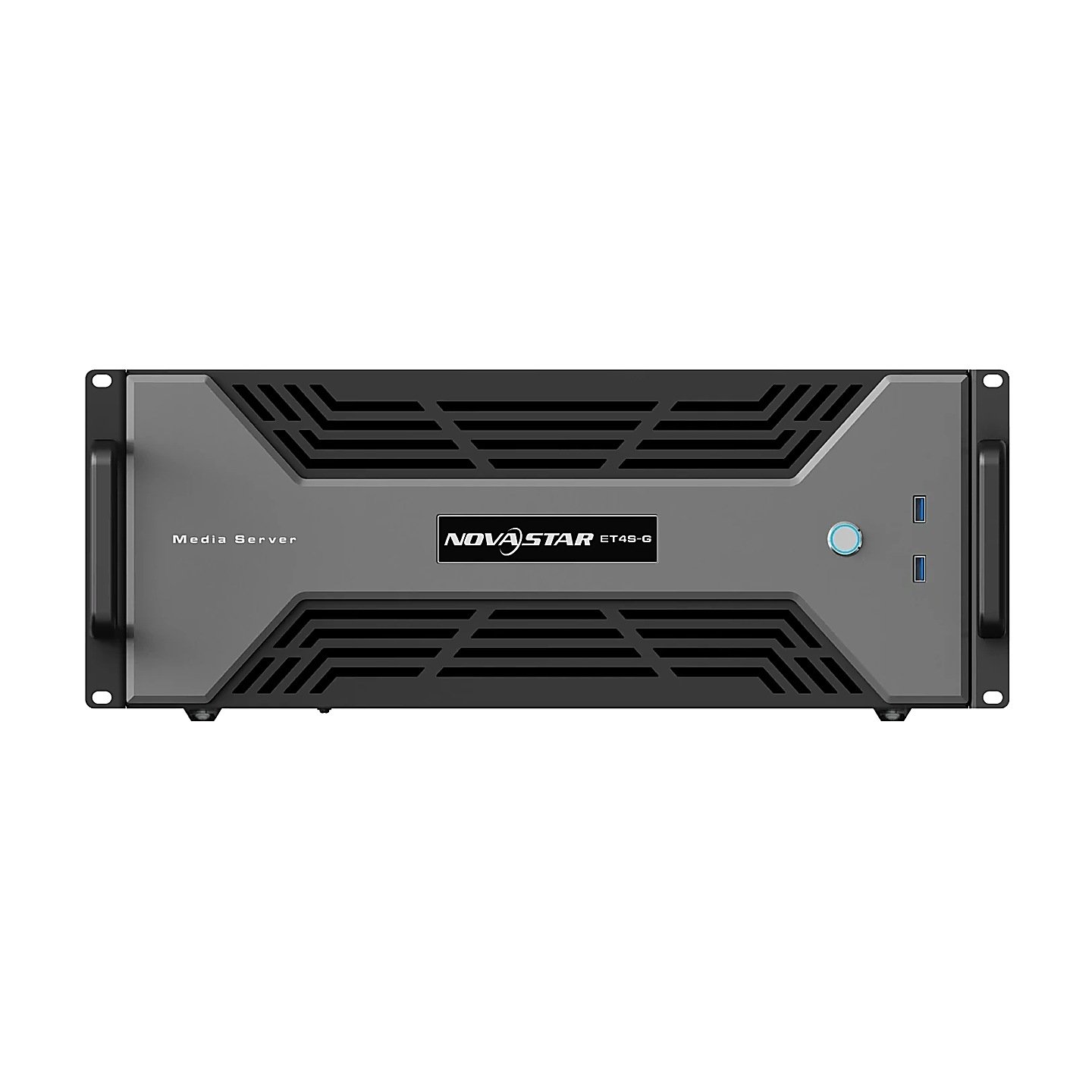
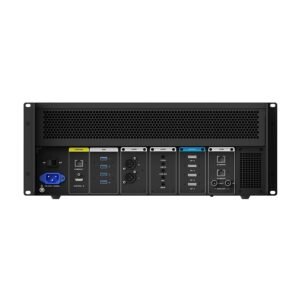
If you have a real 8K master at 60 frames, or anything on the job that has to stay frame-locked, the NovaStar ET4S-G (A4) is the build that carries it. It is the ET4S-G chassis with one HPGA4000 graphics card, running Kompass FX3 and mixing twelve layers over four DP 1.4 outputs.
You end up here for one of two reasons. Either your master really is 8K at 60, or your installation has to stay locked to something else: a second server, a camera, a broadcast reference.
Both of those are hardware decisions you make at the order. The card sets your decoding rate and your mosaic ceiling, and it is also the reason you can fit a sync card at all.
Downstream nothing changes for you. The picture leaves on DisplayPort and a sending card or video processor turns it into the runs your cabinets take.
What the HPGA4000 is documented for
One 8K×4K film at 60 frames, decoded in hardware, on a card with a 256-bit GDDR6 memory bus. That single line is what you are paying for over the P2000 version, which NovaStar rates for 8K at 30 frames.
Thirty frames against sixty is not a subtlety on a wall this size. Camera moves and particle work judder at 30 in a way a still gallery piece never shows, which is why your 8K sizzle reel and your 8K architectural flythrough are not the same order.
The mosaic ceiling moves with the card as well. NovaStar lists the HPGA4000 at 16,384 pixels of mosaic width or height, twice the figure it gives the P2000, so a long concourse ribbon becomes possible for you on this build and not on the other.
The datasheet quotes two different memory sizes for this card in two different tables. Neither figure changes the decoding line or the mosaic figure, which are stated consistently, and those are what your design actually rests on.
Frame lock, BNC sync and the second server
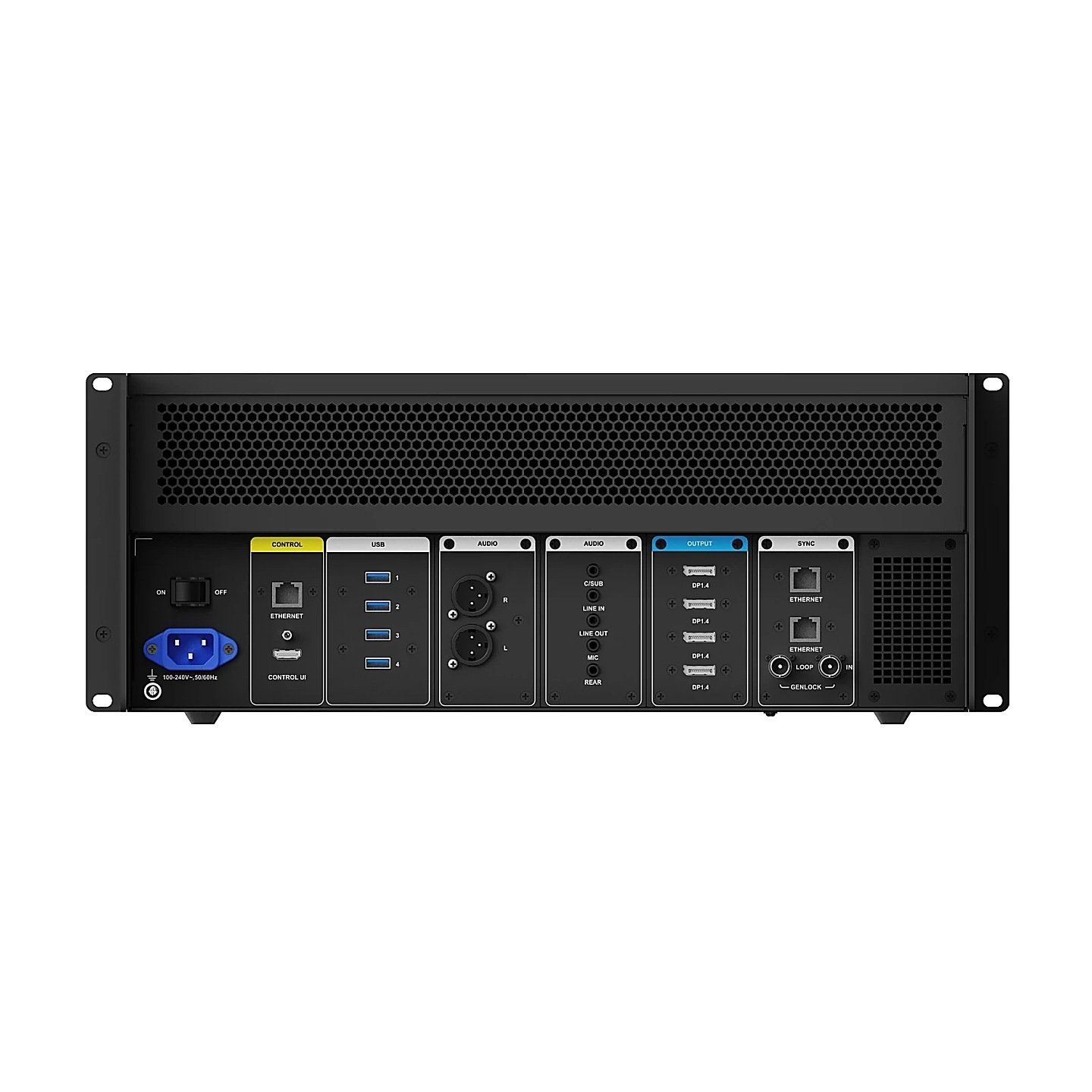
The sync card only pairs with the HPGA cards, so you can fit one here and you cannot on the P2000 build. NovaStar specifies it as two RJ45 ports that accept and pass on a frame-lock signal, one BNC connector for an external sync source, and indicators for the state of each link.
Frame lock is what stops your seam from crawling. Two servers each rendering half of a 20-metre wall drift apart by a frame now and then, and the join shows it as a tear that moves; locking them to one timing removes the tear rather than hiding it.
The BNC input is the broadcast half of the same idea. An external reference from your camera chain or house sync generator keeps the wall on the same cadence as the cameras pointed at it, which is the difference between a usable LED backdrop and one that bands on air.
Kompass FX3 carries the software half in three frame-sync modes, and the one for multiple devices runs continuous calibration rather than a fixed number of passes after a program change.
Plan your content brief around it. NovaStar recommends 110 to 135 Mbps for 8K at 60 on a single server, but where several servers have to stay frame-synchronized it recommends 30 Mbps for the same 8K material in H.265. A synchronized job gets re-encoded, not just re-cabled.
ET4S-G (A4) key features
Surround audio outputs
An attraction with a soundtrack usually leaves you with the audio on a separate machine and a sync problem to go with it. This one carries balanced XLR left and right outputs. The 3.5 mm connectors beside them add center and subwoofer, a rear channel, line in and out, and a microphone input, so your room’s sound leaves the same box as the picture.
Multi-screen management
One server often has to serve rooms that have nothing to do with each other. You arrange and play programs per screen, so a lobby loop, a gallery piece and a meeting-room source run from one machine on separate schedules.
Large stills and image sequences
Panoramic artwork and render-farm output reach you as enormous files rather than video. Kompass FX3 handles image sequences as a media type and documents a maximum image resolution of 50000×3000, which covers a stitched panorama no video codec would survive.
PowerPoint at 4K
Your briefing deck on a fine-pitch wall looks soft the moment it is upscaled from 1080p. Kompass FX3 decodes PowerPoint files up to 4K and holds up to fifteen of them in the media library, which the FX1 and FX2 servers do not.
NovaStar ET4S-G (A4) specifications
These are the values that settle your rack drawing, your content brief and your sync design.
| Graphics card fitted | 1× HPGA4000, GDDR6 on a 256-bit bus |
|---|---|
| Hardware decoding | 1× 8K×4K@60fps SDR |
| Video outputs | 4× DP 1.4, each up to 5120×2880@60Hz |
| Mosaic limit with this card | 16,384 pixels of width or height across the four connectors |
| Playback | 12 mixing layers and 1 audio track; up to 64 partitions per output |
| Sync card | Compatible; 2× RJ45 frame lock and 1× BNC external sync, ordered separately |
| Processor and memory | 12th-generation Intel Core; 32 GB DDR5 on a server-grade board |
| Storage | 250 GB system SSD plus a 1 TB media SSD; 1 TB or 4 TB drives optional |
| Control and network | 1× RJ45 at 2.5 Gb; HDMI CONTROL UI at 2K×1K@60Hz; UDP or TCP/IP remote control; VICP |
| Timecode | External LTC and MTC inputs |
| Software | Kompass FX3 with licensing dongle, on Windows 10 Enterprise LTSC |
| Power | 100–240V~, 47–63Hz; 750 W supply; 500 W maximum consumption |
| Environment | 0°C to +40°C operating; −10°C to +60°C storage; non-condensing |
| Dimensions and weight | 482.6 × 183.5 × 642.0 mm, 17 kg |
| Certifications | CE, FCC, IC, CB, KC, RoHS |
The 40°C ceiling is tighter than it looks once you close a rack around 500 W of server. Budget the airflow, not just the outlet.
Four DP 1.4 outputs and a 16,384-pixel mosaic
You get four connectors, each good for 5120×2880@60Hz, joined into a mosaic up to 16,384 pixels along its long edge. Every connector also takes a custom timing from 480 to 8192 pixels wide and 300 to 8192 high, which is how your portrait columns and letterbox strips share one server.
The mosaic figure is the one worth taking to your screen drawing. A 14,000-pixel concourse run and a 12,000-pixel stage surround both sit inside it, and both are outside what the P2000 build allows.
Layers and partitions do the rest of your shaping. Twelve mixing layers sit on the canvas, and each output divides into as many as 64 sub-outputs you can split, reassemble and rotate to match a wall built in steps or at angles.
Decoding is the ceiling that catches designs out. One 8K×4K film at 60 frames is what the card is documented to decode in hardware, so if your program is built from several simultaneous 8K films you are asking for more than the datasheet promises.
| What you are planning | The limit on this build |
|---|---|
| One DP 1.4 connector | Up to 5120×2880@60Hz, or a custom timing 480–8192 wide by 300–8192 high |
| Mosaic across four connectors | 16,384 pixels of width or height |
| Films decoded in hardware | One at 8K×4K@60fps SDR |
| Layers on screen | 12 mixing layers and 1 audio track |
| Beyond one server | Sync card fitted, and content re-encoded to the frame-sync bitrate |
Match your screen drawing to the mosaic row and your edit to the decoding row. Those two rule out more designs than everything else on the page.
ET4S-G (A4) or ET4S-G (P2): which configuration do you order?
Order the A4 build if you have an 8K master at 60 frames, a mosaic past 8192 pixels or anything that has to be frame-locked; order the P2 build when your content is cut as 4K films and nothing needs genlock.
The A4 build costs about a thousand dollars more and moves three limits. Your decoding goes from 30 frames to 60 at 8K, your mosaic ceiling doubles, and the sync card becomes an option instead of an impossibility.
The P2 build is not a lesser machine for the right brief. NovaStar documents its card for three 4K×2K films at 60 frames, which is more simultaneous 4K playback than the A4 entry names, so a centre-and-wings design built from 4K files is well served by it.
The configurable ET4S-G is your route to everything else, including the HPGA4500 Ada card, extra storage drives and a sync card specified with the order rather than added later.
| Build | Hardware decoding | Mosaic limit | Sync card | Price |
|---|---|---|---|---|
| ET4S-G (P2) | 1× 8K×4K@30fps or 3× 4K×2K@60fps | 8192 px | No | $6,903 |
| ET4S-G (A4) | 1× 8K×4K@60fps | 16,384 px | Yes | $7,976 |
| ET4S-G | Set by the card you choose | Set by the card you choose | With an HPGA card | By quote |
The $1,073 between the two builds buys you 8K at full frame rate and a sync path. Neither can be retrofitted by changing software.
ET4S-G (A4) datasheet, manual and Kompass FX3 licensing
One datasheet covers all three ET4S-G builds. Read its product-selection table first, because that is where the suffix, the card and the decoding rate line up for you; the optional-items table underneath is where the sync-card pairing rule sits.
The Kompass FX3 manual is the software document, shared with the ET16S-G servers. It holds the frame-sync modes, the media-format list and the bitrate tables your synchronized installation has to be encoded against.
Kompass FX3 ships with its licensing dongle on this machine. Pull that dongle out of a running server and your software drops back to trial, which puts the words Kompass FX3 across the wall about five seconds afterwards. Rack it behind a locked door.
NovaStar ET4S-G (A4) FAQ
Is the sync card included with the ET4S-G (A4)?
No. NovaStar lists it under optional items, ordered separately, and it works with the HPGA4000 fitted here as well as the HPGA4500 Ada. Ask for it on the same order if your design needs frame lock.
Can two ET4S-G (A4) servers stay in step across one wall?
Yes, with a sync card in each and Kompass FX3 set to its multi-device frame-sync mode. Re-encode your media first: NovaStar’s recommended bitrate drops sharply once frame synchronization is required.
Does the ET4S-G (A4) drive LED cabinets directly?
No. It outputs DisplayPort, and a sending card or video processor turns that into your cabinet runs. The controller calculator matches your pixel count to the senders we stock.
How many 4K films will the A4 build play at once?
The datasheet names one 8K×4K@60fps film for this card rather than a count of 4K files. Where your brief is explicitly several simultaneous 4K films, the P2 build is the one NovaStar documents for three of them.
How much rack space and cooling does it need?
Five rack units, 642.0 mm of depth and 17 kg, drawing up to 500 W. The operating range stops at 40°C, so if your cabinet is sealed it needs forced air rather than passive venting.
What is included in the box?
The server with the HPGA4000 fitted, plus the cabling and paperwork you need:
- Four DP cables for the four outputs
- Power cable and one HDMI cable
- Keyboard and mouse set
- Safety manual and certificate of approval
What warranty does the ET4S-G (A4) carry?
Three years of serial-tracked manufacturer coverage, supplied through our authorized US NovaStar channel.
Is there volume pricing on more than one server?
Yes. Your multi-unit order is quoted as one line rather than several, and the figure comes back below the listed price; sync cards on the same order are costed with it.
Can we buy on a purchase order or NET terms?
Yes, for approved buyers. Purchase orders and NET terms, Net 30 included, may be available to schools, government buyers, venues and established integrators.
How do I order the ET4S-G (A4)?
Add it to the cart and submit the order request, which takes no payment. We confirm the build, add the sync card if the design needs one, apply volume pricing and send the invoice.
Reviews
There are no reviews yet.