
What is the NovaStar ET1S-G media server?
If your showroom, lobby or boardroom wall has to play finished video on a schedule, the NovaStar ET1S-G is the machine that holds it and puts it out. It is a rack-mount Windows server with NovaStar’s Kompass FX1 built in, and it gives you one picture over DisplayPort or HDMI at up to 4K×2K@60Hz.
That one picture is all you get, and it is the number that decides most jobs. Your layers stack inside it, and the four HDMI 1.3 outputs divide that canvas rather than add to it, so if your design needs two independent canvases you are buying two servers.
You are the right buyer for it if your content arrives finished and changes a few times a year rather than a few times a day. Exhibition walls, retail displays and meeting rooms that run the same scheduled program every morning are where it earns its place.
Nothing downstream of it has to change. You hand its picture to the sending card or video processor you already own, and that unit turns it into the Ethernet or fiber runs your cabinets are wired for. You are buying a source here, not a controller.
ET1S-G key features
Output partitioning
If your screen is built as a T, an L or a stepped ribbon, you normally pay for a re-cut of every video file. Here you cut the canvas instead: one output splits into as many as 1,024 partitions, and Kompass FX1 lets you drag those sub-outputs into the shape your wall was actually built in. Your video plays as it was delivered.
Four playback layers
One video rarely carries your whole design. You get four layers and one audio track running together, so a background loop, a logo, a live clock and a text crawl can share the canvas without anyone pre-compositing them into a single file. A fifth element sends you back for a re-render.
Unattended start-up
A showroom that needs someone to click Play every morning is dark whenever nobody does. You get the software starting itself when mains power returns, and the saved program playing without anyone in the building. A power cut at 3am fixes itself before your doors open.
Live and networked sources
Not every layer you need starts as a file on the drive. Kompass FX1 also plays NDI streams, a web page, a streaming URL and plain text, and it runs your PowerPoint up to 1080p with a laser pointer to move the slides. If your room wants a live dashboard beside the video, you do not need a second machine to capture one.
What the ET1S-G’s six video connectors actually give you
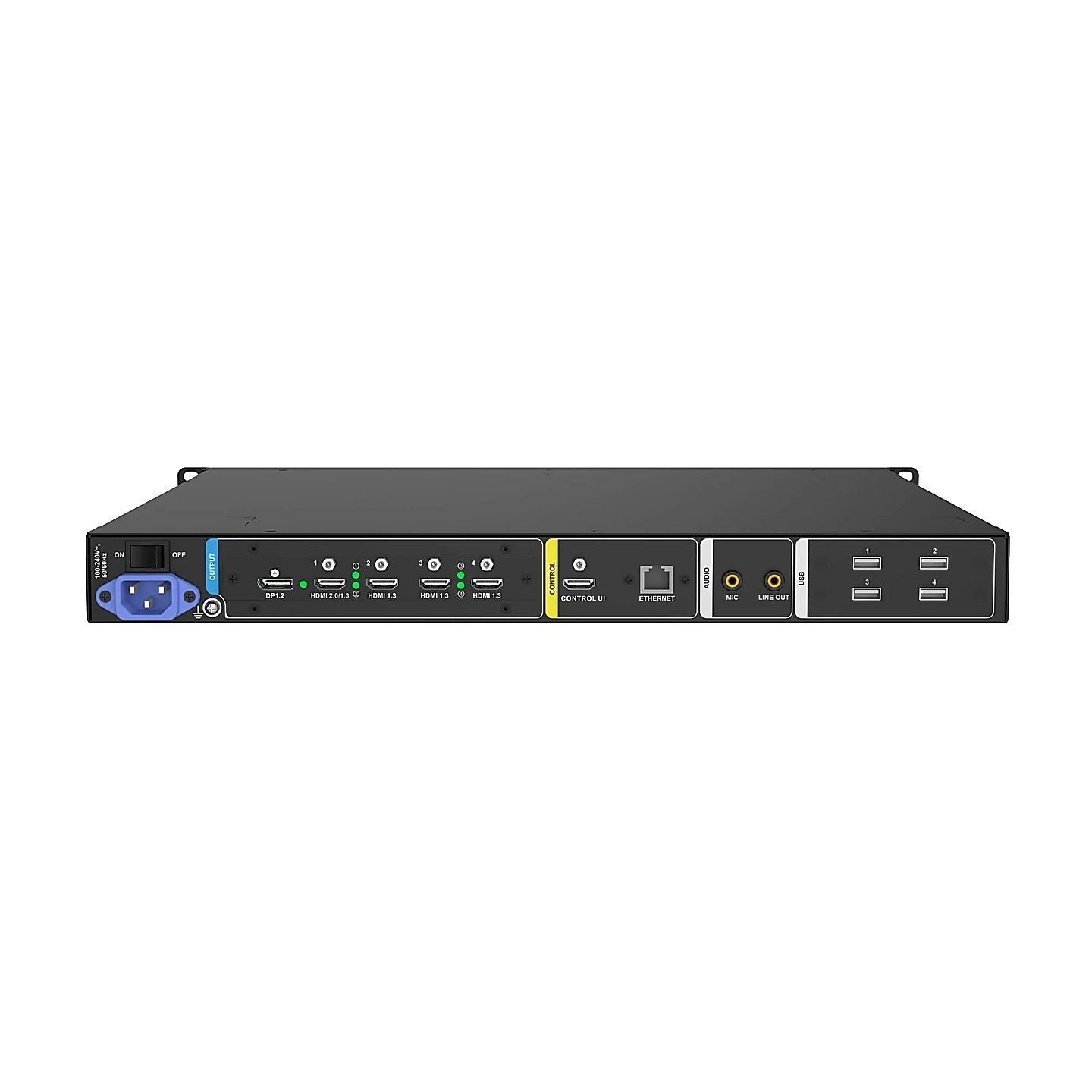
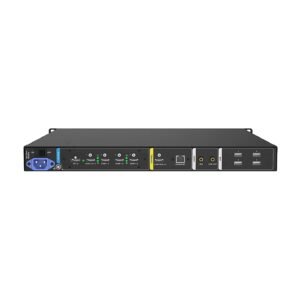
You get six connectors and one picture between them, which is the part buyers most often read the wrong way. DP 1.2 holds your canvas at up to 4K×2K@60Hz, the HDMI 2.0 output copies it, and the four HDMI 1.3 outputs either copy it as well or cut it into a mosaic at up to 2K×1K each.
Switch that port to HDMI 2.0 and you lose three of the four. NovaStar’s connector table says it plainly: with the port set to HDMI 2.0, HDMI 1.3 connectors 2, 3 and 4 are unavailable. It changes how many screens leave your server, so it is worth settling before the rack gets dressed.
Sound never leaves those four HDMI 1.3 outputs, which the datasheet lists as picture only. Your audio rides the DP 1.2 or HDMI 2.0 output at up to 24-bit stereo, or comes off the Line OUT jack to the room amplifier. Wire a screen on HDMI 1.3 and expect embedded sound, and your room stays silent.
One EDID setting covers all four HDMI 1.3 outputs, so a change you make to one connector lands on all four. The datasheet rules out setting them individually, which means four screens on four different timings is not something you can ask this server for.
Output timing arrives locked, and the SCT tool that starts with the machine is where you unlock it. Custom timings run to 7680 pixels wide by 4095 high, so an ultra-wide ribbon fits one of your outputs by trading height for width.
In pass-through mode the main connector you select has to be plugged in. The manual is explicit that with it disconnected, neither the main output nor its copies carry data, so somebody pulling the cable from the port nobody uses takes your wall down with it.
Every video output on this server is 8-bit. If your project is specified for a 10-bit path into the processor, you need a different source.
| Connector | Maximum | What it carries | Audio |
|---|---|---|---|
| 1× DP 1.2 | 4K×2K@60Hz | The canvas | Up to 24-bit, two channels |
| 1× HDMI 2.0 | 4K×2K@60Hz | A copy of the DP 1.2 output | Up to 24-bit, two channels |
| 4× HDMI 1.3 | 2K×1K@60Hz each | A copy of the canvas, or a mosaic of it in 1×2, 1×3, 1×4, 2×1, 2×2, 3×1 or 4×1 | None |
| 1× CONTROL UI | 2K×1K@60Hz | The operator monitor, not screen content | Not applicable |
The CONTROL UI connector is the one that costs you nothing. Your operator monitor has its own port, so you never give up a screen output to run the machine.
NovaStar ET1S-G specifications
These are the figures you check against your rack drawing, your power schedule and any hope of growing the machine later.
| Output capacity | 1× 4K×2K@60Hz, one canvas |
|---|---|
| Video connectors | 1× DP 1.2, 1× HDMI 2.0, 4× HDMI 1.3, plus a separate CONTROL UI connector |
| Color handling | 8-bit; RGB 4:4:4, YCbCr 4:4:4 and YCbCr 4:2:2; full and limited range; HDCP; EDID lock |
| Playback | Up to 4 layers and 1 audio track; up to 1,024 partitions per output |
| Processor | Intel Core i3-1215U, 6 cores and 8 threads, 1.2 GHz base and 4.4 GHz turbo |
| Memory and storage | 16 GB DDR4 at 2666 MT/s; one 256 GB SSD |
| Expansion | Integrated graphics; no PCIe slots on the motherboard |
| Network, USB and audio | 1× Gigabit RJ45; 2× USB 3.0 front and 4× USB 2.0 rear; MIC in and Line OUT |
| Software | Kompass FX1 on Windows 10 Enterprise LTSC |
| Power | 100–240V~, 50/60Hz; 80 W maximum |
| Environment | 0°C to +45°C operating; −10°C to +60°C storage; non-condensing |
| Dimensions and weight | 482.6 mm wide, 407.5 mm deep, 50.1 mm high; 5.2 kg |
| Mounting | Horizontal only, four M5 screws, 19-inch rack rated for four times the mounted weight |
| Certifications | CE, FCC, IC, RCM, CB, KC |
No card slots and a single SSD, which means that if your canvas grows later you are buying a bigger server rather than a better graphics card.
What goes between the ET1S-G and the LED wall
You need a sending card or a video processor in between, and you probably already own one. The ET1S-G puts out a video signal; something has to turn that into the Ethernet or fiber runs your cabinets take. Any NovaStar sending card or video processor with a DisplayPort or HDMI input will do it.
On the DP 1.2 output, the MCTRL4K, VX2000 Pro, MX40 Pro and CX40 Pro take the signal directly. On the HDMI 2.0 output, add the MX30. On the four HDMI 1.3 outputs, a 2K signal suits the smaller senders such as the VX600.
The connector is the easy half of your decision. A 4K×2K canvas runs to roughly 8.8 million pixels, which is more than most single senders load: an MX30 or a VX1000 carries 6.5 million at 8-bit, an MX40 Pro or a CX40 Pro carries 9 million. If your wall fills the canvas, you are buying one of the larger units or splitting it across two senders.
Match your pixel count first and the connector second. Put your screen’s pixel count into the controller calculator and it returns every sender we stock that carries it.
How much content fits on the ET1S-G’s 256 GB drive
You get about five to six hours of 4K on it, using NovaStar’s own numbers. The recommended bitrate for 4K at 50 or 60 Hz is 53 to 68 Mbps, which works out at roughly 24 to 31 GB for every hour of your finished content.
The drive is a single 256 GB SSD and Windows lives on it too, so what you can actually fill sits below the label. A 1080p program is a different story: at the recommended 12 Mbps an hour costs you about 5 GB, and a day-long loop still leaves room.
The datasheet lists one SSD and no PCIe slots, so size your library around 256 GB rather than around an upgrade you cannot make. When your 4K playlist outgrows it, the ET1S-500G answers the same brief with a 500 GB drive.
ET1S-G, ET1S-500G or ET2S-G: which one do you order?
Three machines cover the small end, and your canvas size decides first, your library size second.
Order the ET1S-G if one canvas covers your screens, four layers cover your design, and your 4K library fits inside 256 GB.
Order the ET1S-500G if your job carries a longer 4K library. Its published specification puts an AMD Ryzen 5th-generation processor behind a 500 GB drive, and lists the four HDMI 1.3 outputs as defaulting to a 2×2 layout where the ET1S-G lists seven. Check the layout before you switch on drive size alone.
Order the ET2S-G if your canvas has to be wider than 4K or your design needs more than four layers. It plays one 8K×2K@60Hz layer or two 4K×2K@60Hz layers and mosaics across 1× DP 1.2 and 2× HDMI 2.0.
Order a Taurus player instead if your screen only runs a scheduled playlist. A TB-series player plays the content and drives the cabinets itself, so one box replaces both the server and the sender. What you give up is the layers, the live sources and the partitioning that squares up an irregular screen.
| Model | Canvas ceiling | Layers | Drive | Price |
|---|---|---|---|---|
| ET1S-G | 4K×2K@60Hz | 4 | 256 GB | $1,099 |
| ET1S-500G | 4K×2K@60Hz | 4 | 500 GB | $1,182 |
| ET2S-G | 8K×2K@60Hz | 8 | 500 GB | $2,062 |
The bigger drive costs you $83. The wider canvas and the extra four layers cost $963.
ET1S-G datasheet, manual and Kompass FX1 licensing
Two documents cover this server, and they answer different questions for you. The ET1S-G datasheet holds the connector limits, the hardware list and the environmental figures. The Kompass FX1 manual holds the playback software, the output editor and the SCT timing tool, and it is NovaStar’s software manual rather than a per-unit hardware manual.
Kompass FX1 is licensed by a USB dongle or a registration code. Without one, the software runs in trial and prints the words Kompass FX1 across the output. Pull a working dongle out and that watermark is back on the wall within about five seconds.
The ET1S-G datasheet names Kompass FX1 as built-in software without naming a dongle, where the ET2S-G and ET4S-G datasheets say the dongle is included. Settle your license on the order rather than on delivery day.
NovaStar ET1S-G FAQ
Can two ET1S-G servers share one screen?
Yes, as a master and a slave on the same network segment. Kompass FX1 states that it does not do frame sync playback, so content that has to line up across the join belongs on one server, or on an ET4S-G configured with a sync card.
Does the ET1S-G need NovaLCT?
No. NovaLCT configures receiving cards and senders. The server’s own output timing and firmware updates run in the SCT tool, which installs with Kompass FX1 and starts with the machine.
Can the ET1S-G play 8K content?
No. Its output tops out at one 4K canvas, and NovaStar recommends H.264 for material at 4K or below. An 8K master belongs on the ET2S-G or a larger server.
Is the ET1S-G rack-mountable?
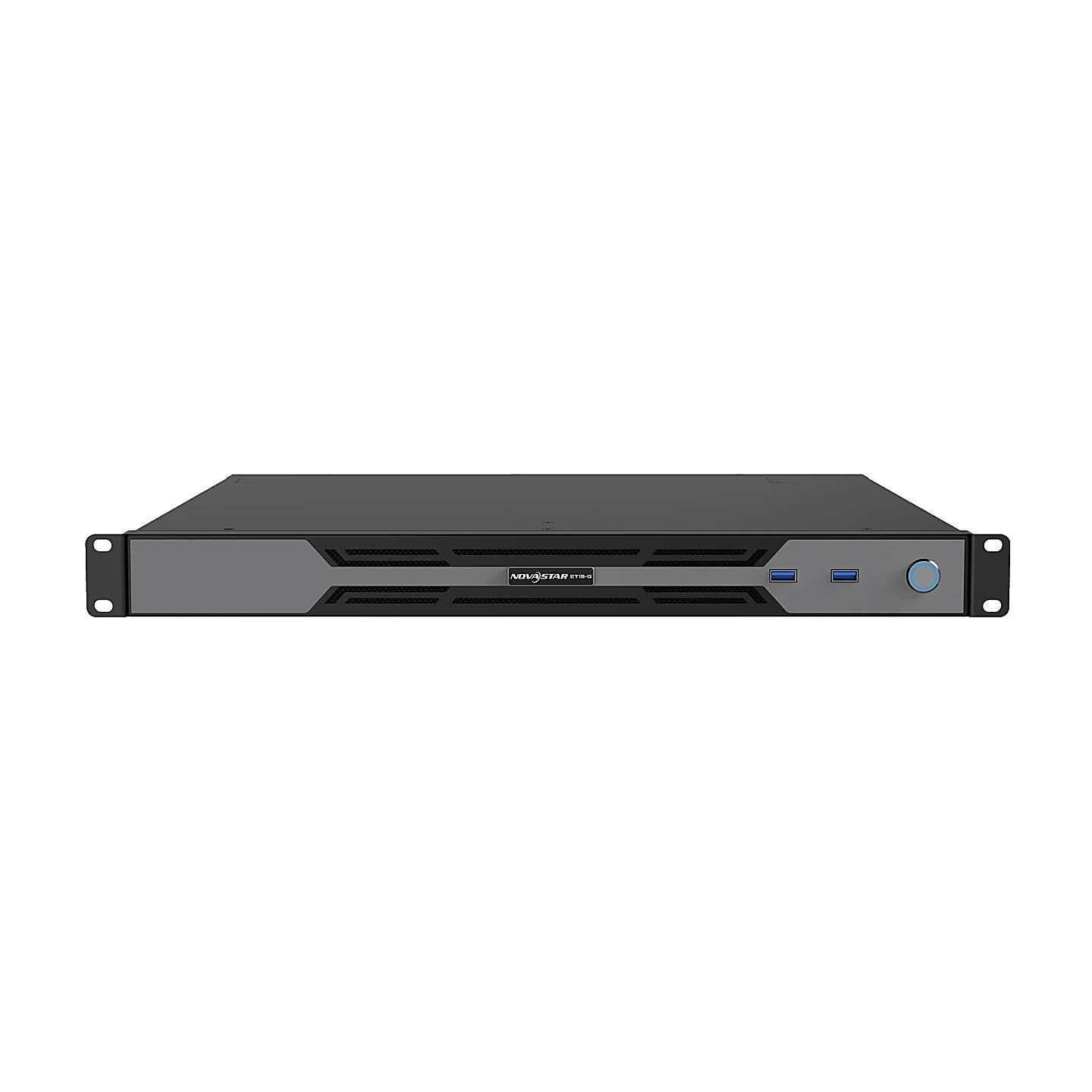
Yes, horizontally, with four M5 screws in a 19-inch rack rated for four times the mounted weight. NovaStar rules out vertical and upside-down mounting. Plan a 1U opening and confirm the height with the order if the rack is tight.
What comes in the box?
The server, its cables and its paperwork. NovaStar lists the accessories as:
- Power cable, two HDMI cables and one DP 1.2 cable
- Cat5e Ethernet cable
- Keyboard and mouse set
- Label carrying the Windows product key
- Quick start guide, safety manual and certificate of approval
What warranty does the ET1S-G carry?
Three years of serial-tracked manufacturer coverage, supplied through our authorized US NovaStar channel.
Is there volume pricing on more than one server?
Yes. Send the model and the count and we price it below the listed figure, and a multi-site rollout is quoted as one order.
Can we buy on a purchase order or NET terms?
Yes, for approved buyers. Purchase orders and NET terms, Net 30 included, may be available to schools, government buyers, venues and established integrators.
How do I order the ET1S-G?
Add it to the cart and submit the order request. Nothing is charged at that point: we confirm stock and quantity, apply volume pricing and send the invoice.
Reviews
There are no reviews yet.