
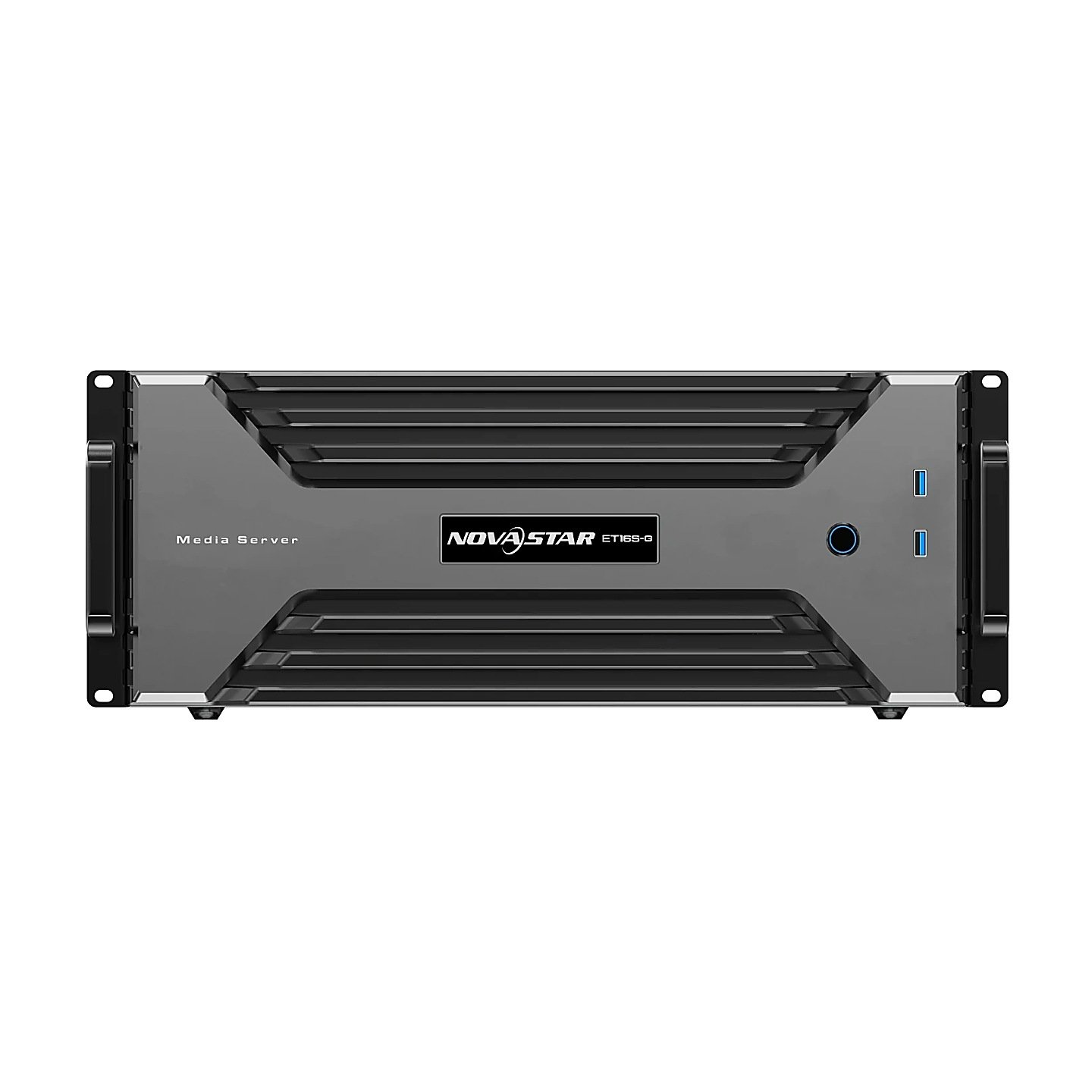
What is the NovaStar ET16S-G (3A4)?
If you have twelve outputs to feed and three 8K films to run at once, the NovaStar ET16S-G (3A4) is the build that carries it. Two Intel Xeon Gold 6226R processors and 128 GB of ECC memory sit behind three HPGA4000 graphics cards, a control card and a Sync Card II, all running Kompass FX3.
Three cards gives you twelve DP 1.4 outputs and three 8K films decoding at once. A gallery driving walls, floor and ceiling as three surfaces arrives at that specification, and so does a control room where three operator walls have to hold the same second.
Where it separates from the two-card version is underneath the cards. NovaStar pairs the third card with a second processor, twice the memory and a second drive, because your platform has to keep three of them supplied.
Your video still leaves on DisplayPort. Sending cards or video processors carry it from there to the cabinets, usually several of them at this size.
Twelve DP outputs and three 8K films
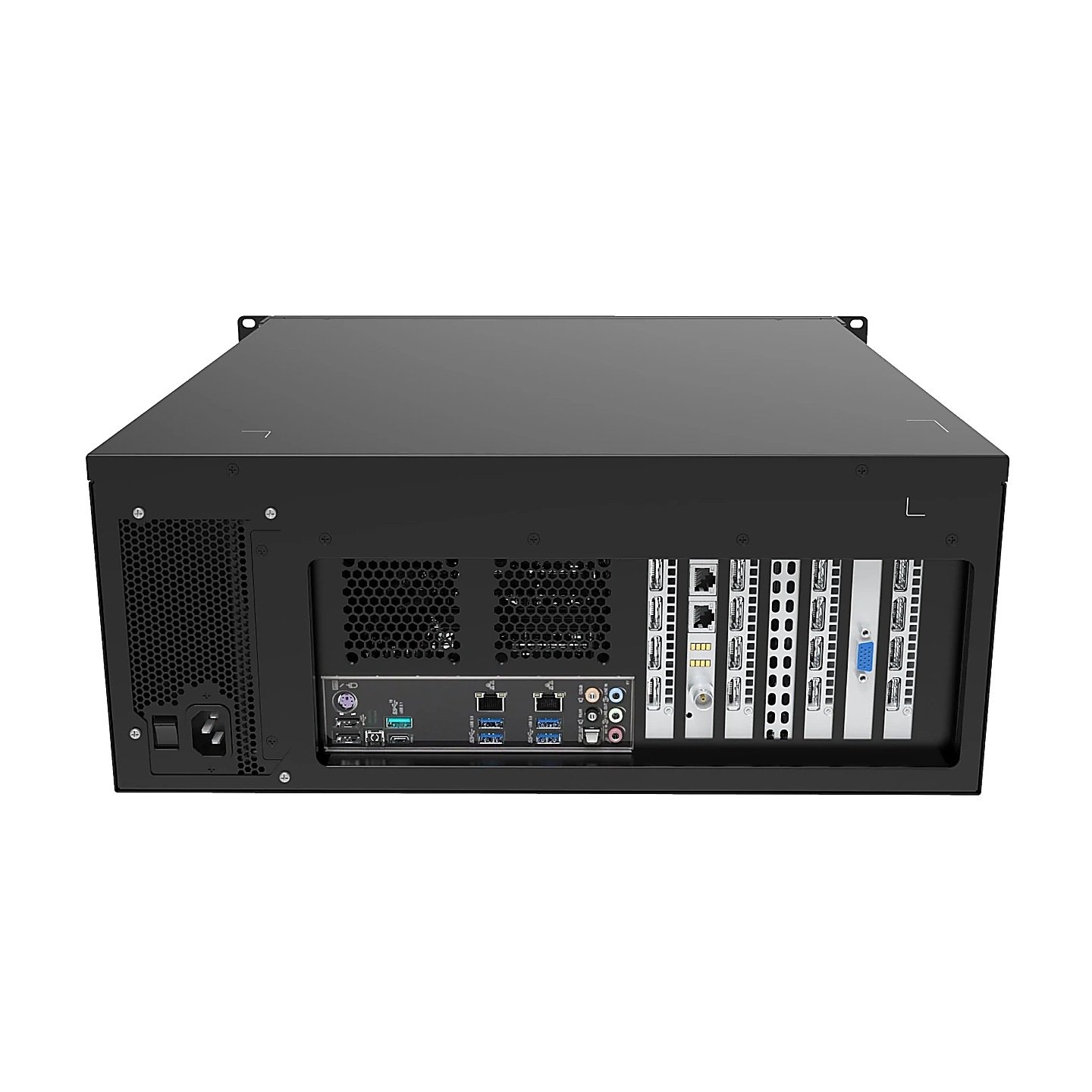
You get twelve DP 1.4 connectors, each running up to 5120×2880@60Hz, in three independent groups of four. Each group belongs to one card, and you form a mosaic inside a group rather than across the machine.
Each card takes its four connectors up to 16,384 pixels along the long edge, so this build offers you three such canvases. A project with three large surfaces fits it exactly; one continuous 40,000-pixel run does not, whatever the total output count suggests.
Decoding scales the same way. NovaStar rates one HPGA4000 for a single 8K×4K film at 60 frames, which puts three of yours across this build, with Kompass FX3’s twelve mixing layers arranged over the top.
Twelve outputs is also twelve cables and twelve sender inputs. Count your downstream side before the order, because the server is rarely the part that runs out.
Why the third card comes with a second processor
Because NovaStar specifies it that way, and the reason is throughput rather than marketing. The two-card build runs one Xeon Gold 6226R with 64 GB; this one runs two of them with 128 GB and adds a 960 GB drive beside the terabyte.
Decoding is only the last step. Your files come off the drive, through the processor and into the card, and three cards asking for 8K frames at 60 a second is a different demand on that path than two.
The second drive changes what you can hold as well. Roughly 50 to 60 GB per hour of 8K at NovaStar’s recommended bitrate puts around thirty hours of finished content on the pair, where a single terabyte holds closer to seventeen.
None of that is retrofittable in an afternoon. Buy the two-card build and add a card later and you are buying a processor, memory and a drive as well, which is why the two builds are priced as different machines rather than as options.
Frame sync across three cards and across servers
Three cards in one chassis have to be locked to each other before anything else matters to you. The MPGT400 supplied with this build is what NovaStar names for multi-card synchronization, and it drives the operator interface on three Mini DP connectors rather than any screen content.
Across machines the job passes to the Sync Card II, fitted here from the factory. Two RJ45 ports accept and pass on a frame-lock signal so you can chain servers, and a BNC input takes an external reference from your camera chain or a house sync generator.
Kompass FX3 carries three frame-sync modes to match. Two of them handle a multi-card configuration and recalibrate a set number of times after a program change; the third is for multiple devices and calibrates continuously instead.
Your content brief moves with the decision. NovaStar recommends 110 to 135 Mbps for 8K at 60 frames on a single server, and 30 Mbps in H.265 for the same material once several servers and cards have to stay frame-synchronized. Encode for the architecture you are actually building.
ET16S-G (3A4) key features
Twelve mixing layers
A room with three surfaces rarely wants three plain films. Twelve layers and one audio track run together with individual size and priority, so each surface can carry its own film plus shared elements without you baking any of it into the media.
Frame sequence playback
Render farms deliver you numbered stills, not video files, and transcoding a 12K sequence to get it on a wall costs a day. You play bmp, tiff, tga, jpg and png sequences directly from the media library.
Timecode-driven playback
An attraction that starts from a show controller cannot start from a mouse. External LTC and MTC inputs let your lighting, audio or show system drive playback position, so every surface lands on the same cue.
Multi-screen management
Three surfaces on one machine are rarely three copies of the same thing. You arrange and play programs per screen, so each surface keeps its own schedule and its own content while the frame lock holds them to one clock.
NovaStar ET16S-G (3A4) specifications
These are the figures that settle your output count, your content brief and your rack drawing.
| Graphics cards fitted | 3× HPGA4000, plus 1× MPGT400 for the interface |
|---|---|
| Video outputs | 12× DP 1.4, each up to 5120×2880@60Hz |
| Hardware decoding | One 8K×4K@60fps film per card, so three across this build |
| Mosaic | Up to 16,384 pixels per card, in one of the seven layouts NovaStar permits |
| Playback | 12 mixing layers and 1 audio track; up to 64 partitions per output |
| Sync | Sync Card II fitted: 2× RJ45 frame lock and 1× BNC external sync |
| Processors and memory | 2× Intel Xeon Gold 6226R; 128 GB ECC DDR4 as standard, expandable |
| Storage | 1 TB plus 960 GB SSDs as standard |
| Control and network | 2× RJ45; 3× Mini DP interface outputs at up to 4096×2160@60Hz; UDP or TCP/IP; VICP |
| Audio | 1× mic in, 1× line in, 3× line out for six channels, and S/PDIF optical out |
| Timecode | External LTC and MTC inputs |
| Software | Kompass FX3 with licensing dongle, on Windows 10 Enterprise LTSC |
| Power | 100–240V~, 8A, 50/60Hz; 1300 W supply; 1100 W maximum consumption |
| Environment | 0°C to +40°C operating; −10°C to +60°C storage; non-condensing |
| Dimensions and weight | 482.6 × 183.5 × 569.8 mm; 17.9 kg net, 24.5 kg gross |
| In the box | Power cable, Mini DP to HDMI and VGA to HDMI adapters, keyboard and mouse, plus the twelve DP cables listed with this configuration |
| Certifications | CE, FCC, IC, CB, KC, RoHS |
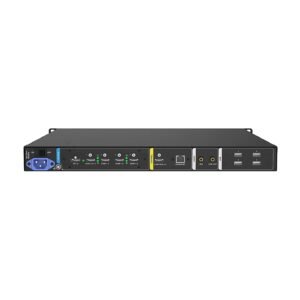
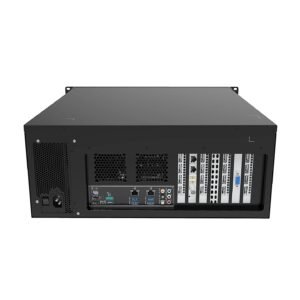
Five rack units, 1100 W and a 40°C ceiling, in a cabinet that has to swallow twelve DisplayPort tails. Plan your airflow and your cable management together, because at this depth one restricts the other.
ET16S-G (3A4) or (2A4): which build do you order?
Order the 3A4 build when your design needs twelve outputs or a third 8K film; order the 2A4 build when eight outputs and two 8K films cover it and your budget is better spent downstream.
Outputs are the hard count. Four DP connectors per card is fixed, so a nine-output design already needs three cards even if every source you have is 4K.
Your 8K count is the second test. Three simultaneous 8K films at 60 frames need three cards, whether or not the output count would have allowed two.
Everything else follows the cards. This build brings the second Xeon Gold 6226R, 128 GB rather than 64, and a second drive, so the step is a platform change rather than a card added to the same machine.
The bare ET16S-G platform is your order when the cards should be HPGA4500 Ada or HPGA6000 rather than HPGA4000. NovaStar lists the HPGA6000 for three 8K×4K films on a single card, which is a different way to reach the same place.
| Build | Cards | DP outputs | 8K films at 60fps | Platform | Price |
|---|---|---|---|---|---|
| ET16S-G (2A4) | 2× HPGA4000 | 8 | 2 | 1× Xeon Gold, 64 GB, 1 TB | $17,013 |
| ET16S-G (3A4) | 3× HPGA4000 | 12 | 3 | 2× Xeon Gold, 128 GB, 1 TB + 960 GB | $25,156 |
| ET16S-G platform | Chosen at order | 4 per card | Set by the cards | Confirmed on the quote | $8,000 |
The $8,143 between the sealed builds is a card, a processor, 64 GB of memory and a drive. Bought separately later it is also a rebuild and a re-commissioning for you.
ET16S-G (3A4) datasheet, manual and Kompass FX3 licensing
One datasheet covers every ET16S-G build. The product-selection table is where the suffix, the card count, the processor count and the memory line up for you; the optional-items table beneath it specifies each card the chassis accepts, including the ones no sealed build carries.
The Kompass FX3 manual is the software document, shared with the ET4S-G servers. It holds the three frame-sync modes, the media formats and the two bitrate tables that decide how your synchronized installation is encoded.
Kompass FX3 ships with its licensing dongle. Remove it from a running machine and your software falls back to trial, putting its own name across every output about five seconds later.
NovaStar ET16S-G (3A4) FAQ
How many outputs does the ET16S-G (3A4) have?
Twelve DP 1.4 connectors, four from each of the three HPGA4000 cards, at up to 5120×2880@60Hz each. The three Mini DP connectors on the control card are for the software interface, not for your screens.
Can a fourth card be added?
The chassis takes at most four graphics cards, so a fourth is a configuration question rather than a sealed build. Quote it on the bare platform instead of adding one to a finished machine.
How much 8K content will the drives hold?
Around thirty hours. NovaStar recommends 110 to 135 Mbps for 8K at 60 frames, roughly 50 to 60 GB an hour, against the 1 TB plus 960 GB you get installed.
Do several ET16S-G servers stay in step with each other?
Yes, through the Sync Card II fitted to each and the multi-device frame-sync mode in Kompass FX3. Re-encode your media first, because NovaStar’s recommended bitrate drops once frame synchronization is required.
Does the ET16S-G (3A4) drive LED cabinets directly?
No. It outputs DisplayPort, and sending cards or video processors convert that to your cabinet runs. The controller calculator matches your pixel count to the senders we stock.
How much power and rack space does it need?
Five rack units, up to 1100 W from a 1300 W supply, 569.8 mm of depth and 17.9 kg on your rails, in an ambient no warmer than 40°C.
What warranty does the ET16S-G (3A4) carry?
Three years of serial-tracked manufacturer coverage, supplied through our authorized US NovaStar channel.
Is there volume pricing on more than one server?
Yes. Give us your count and your sites together and the figure comes back below the single-unit price.
Can we buy on a purchase order or NET terms?
Yes, for approved buyers. Purchase orders and NET terms, Net 30 included, may be available to schools, government buyers, venues and established integrators.
How do I order the ET16S-G (3A4)?
Add it to the cart and submit the order request, which takes no payment. We confirm the build and the lead time, apply volume pricing and send the invoice for approval.
Reviews
There are no reviews yet.