
What is the NovaStar ET16S-G?
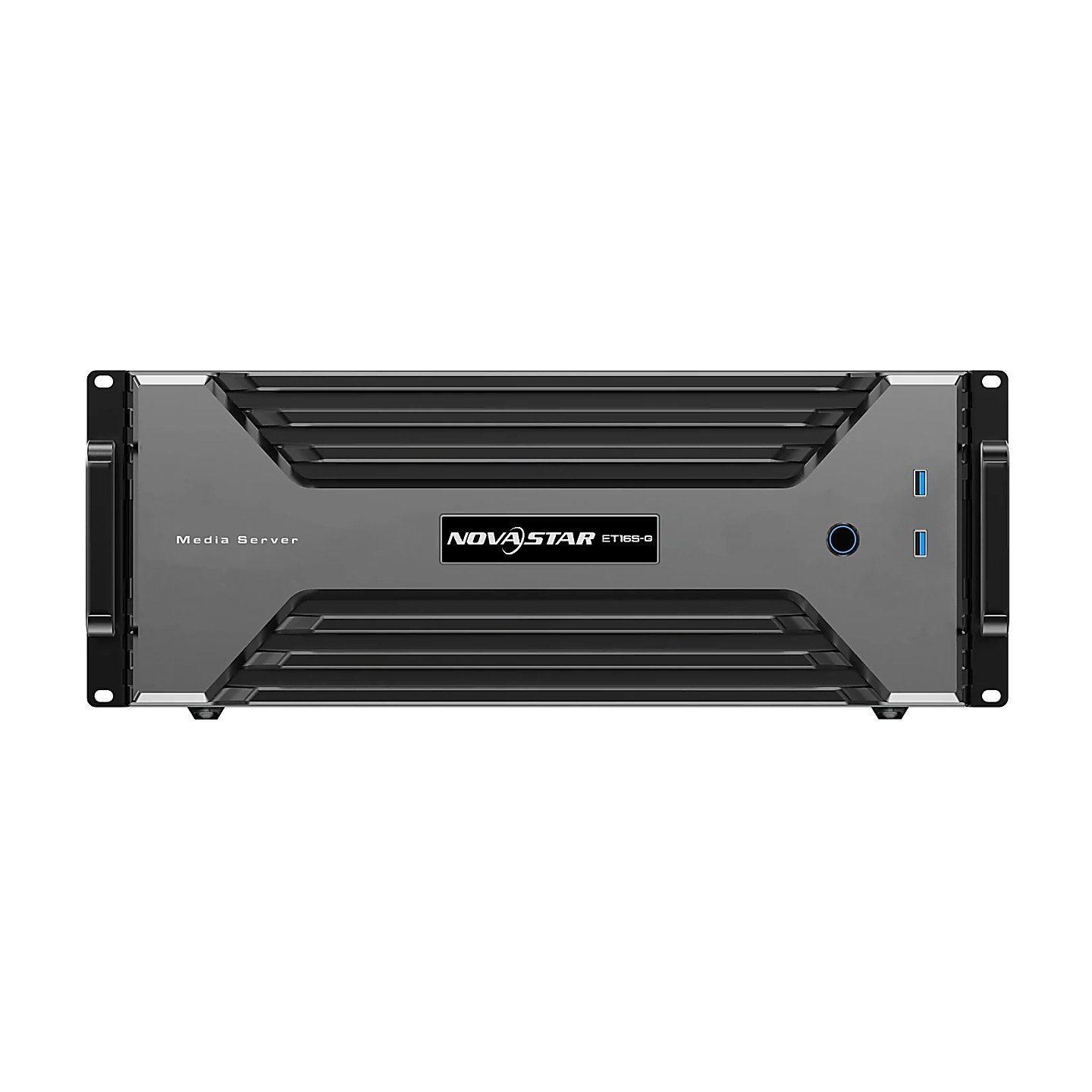
If the card choice on NovaStar’s largest media server is yours to make, this is the line you order. The NovaStar ET16S-G gives you the platform underneath it: an Intel Xeon Gold 6226R workstation with ECC memory, a terabyte of SSD and a licensed copy of Kompass FX3, supplied before any graphics cards go in.
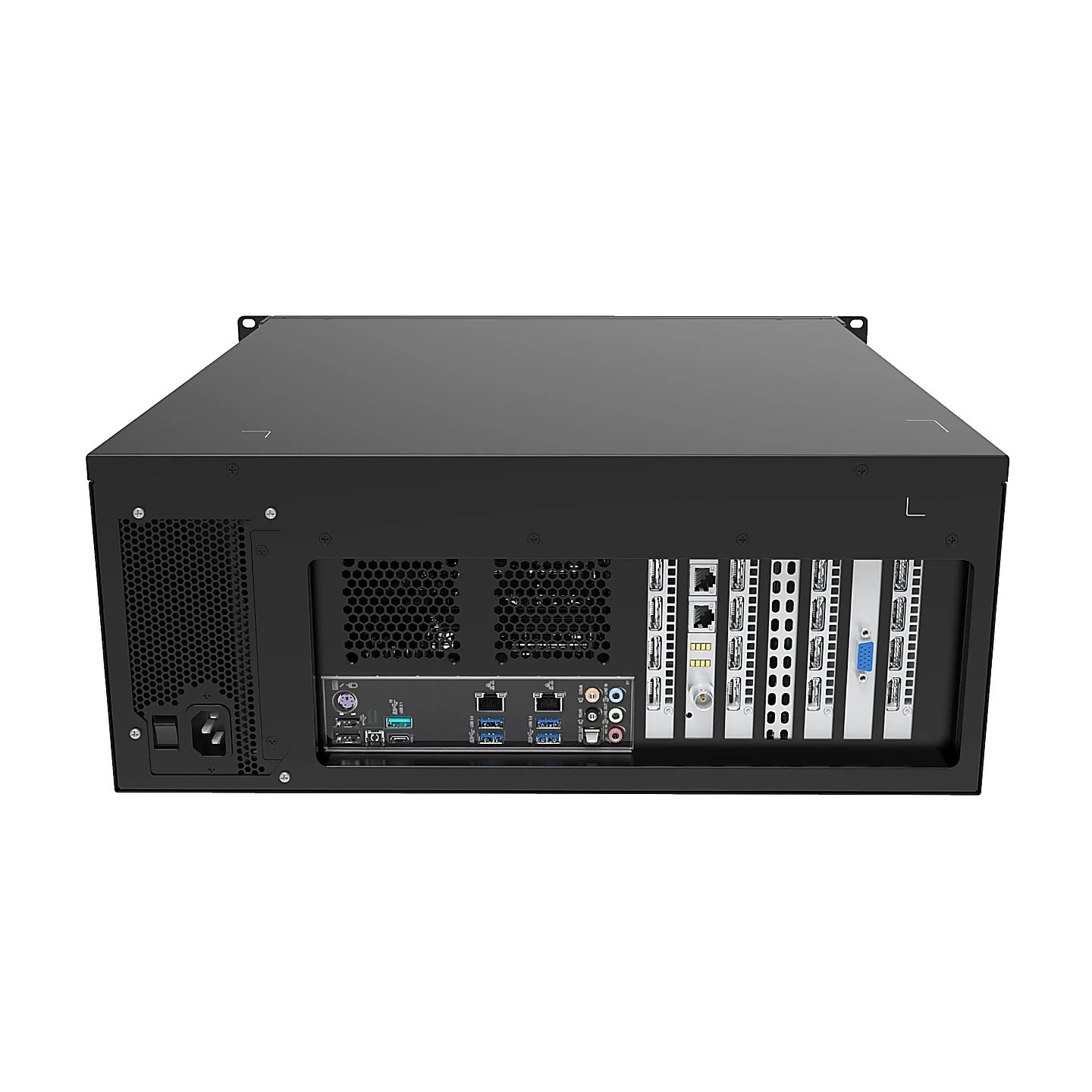
Everything this server can do for you is decided by what fills those slots. The chassis takes at most four cards, each one adding four DP 1.4 outputs, and the card model sets how many 8K films decode at once.
You buy the platform when you want an HPGA6000 for decoding rather than output count, an HPGA4500 Ada, or a card count no sealed build carries.
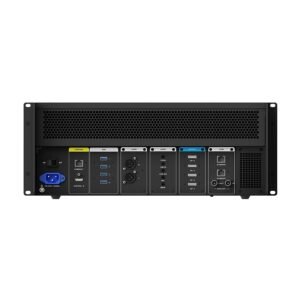
Everything else is the same machine as the ready-made builds. Twelve mixing layers, LTC and MTC timecode and the 5U chassis come with the platform, and so do the six-channel and optical audio outputs and the two Gigabit ports.
What the ET16S-G platform ships without
Graphics cards, and therefore video outputs. Every DP 1.4 connector on this server lives on a graphics card, so if you order the platform on its own you have no way to reach a screen until at least one card is specified with it.
The connector left on the back is the VGA, and NovaStar is explicit that it exists to show the software interface and to install the system in production. It is not a picture output for your wall.
The three Mini DP interface connectors sit on a card as well. They belong to the MPGT400, which NovaStar lists as an optional item rather than as part of the chassis.
None of this is a fault in the product; it is what configurable means. It does mean that a purchase order listing only the platform arrives as a server you cannot plug a screen into.
ET16S-G key features
Output partitioning and rotation
Large installations are rarely built as rectangles, and re-cutting media for every surface shape is the expensive way for you to solve that. Each output divides into as many as 64 sub-outputs you can move, reassemble and rotate, so a stepped wall or an angled fin takes its own slice of the canvas.
Layer keying and blurring
A logo delivered on black becomes a grey rectangle the moment it lands on a bright surface. Your layers take masking, cropping, keying, blurring and opacity, which is how a caption or a badge sits on the image instead of on a box.
Live and pre-edit modes
Editing a running program in front of visitors is how a wall ends up showing your half-built work. Pre-edit keeps the changes off the outputs until you send them, and live mode is there for the times a change really is meant to happen now.
The graphics cards this chassis takes
Three cards, with a different maximum count for each, and your choice decides two separate things: how many outputs the server has and how much 8K it decodes.
| Card | Maximum fitted | DP outputs each | 8K×4K@60fps films each | Memory |
|---|---|---|---|---|
| HPGA4000 | 4 | 4 | 1 | GDDR6 on a 256-bit bus |
| HPGA4500 Ada | 2 | 4 | 1 | 24 GB GDDR6, 192-bit |
| HPGA6000 | 2 | 4 | 3 | 48 GB GDDR6, 384-bit |
Outputs and decoding do not scale together, and that is the useful part of this table for you. Four HPGA4000 cards reach sixteen outputs and four 8K films; two HPGA6000 cards reach eight outputs and six.
So count your physical screens first and your 8K sources second. A twelve-surface operations wall fed from 4K sources wants card count; a three-surface immersive room running 8K masters wants decoding, and those two answers point you at different cards.
Every card takes its own four connectors up to a 16,384-pixel mosaic, in one of the seven layouts NovaStar permits, with all connectors in a mosaic running the same output resolution. Each card also arrives with four DP cables of its own.
The card is the part you cannot undo by configuration. Choose it against your screen drawing rather than the price list.
MPGT400 and Sync Card II: the two cards that are not outputs
Both matter more than their size suggests, and both belong on your first purchase order. NovaStar names the MPGT400 as the requirement for multi-card synchronization and the server sync card as the requirement for synchronizing more than one server.
The MPGT400 also carries your operator interface on three Mini DP connectors and drives nothing else. Without it, your interface monitor has to come off a card the wall needs, or off the production VGA.
The Sync Card II is the machine-to-machine half. Two RJ45 ports accept and pass on a frame-lock signal so you can chain servers, and a BNC input takes an external reference from your camera chain or house sync. It pairs with any of the three HPGA cards.
Skip either one and the fault shows up late for you. Cards that are not locked together let the join between two surfaces drift, and no amount of re-cabling settles it.
NovaStar ET16S-G platform specifications
Everything below comes with the platform. Only the output count, the decoding and the mosaic move with the cards you add.
| Output capacity | Up to 16K×8K with the chassis fully populated; four DP 1.4 connectors per card |
|---|---|
| Graphics card slots | At most four cards, supplied empty in this configuration |
| Processor and memory | 1× Intel Xeon Gold 6226R with 64 GB ECC DDR4 as supplied, expandable; a dual-processor platform with 128 GB is quoted separately |
| Storage | 1 TB SSD; the dual-processor platform adds a 960 GB drive |
| Playback | 12 mixing layers and 1 audio track; up to 64 partitions per output |
| Control and network | 2× RJ45; UDP or TCP/IP remote control; VICP; a VGA connector for the interface only |
| Audio | 1× mic in, 1× line in, 3× line out for six channels, and S/PDIF optical out |
| Timecode | External LTC and MTC inputs |
| Software | Kompass FX3 with licensing dongle, on Windows 10 Enterprise LTSC |
| Power | 100–240V~, 8A, 50/60Hz; 1300 W supply; 1100 W maximum consumption |
| Environment | 0°C to +40°C operating; −10°C to +60°C storage; non-condensing |
| Dimensions and weight | 482.6 × 183.5 × 569.8 mm; 17.9 kg net, 24.5 kg gross; horizontal mounting only |
| In the box | Power cable, Mini DP to HDMI and VGA to HDMI adapters, keyboard and mouse; card cables arrive with the cards |
| Certifications | CE, FCC, IC, CB, KC, RoHS |
Five rack units and 1100 W before a single card is fitted. Size your circuit and your airflow for the finished machine, not for the platform as it arrives.
When a sealed 2A4 or 3A4 build is the better order
Order the 2A4 build if you need eight outputs and two 8K films, or the 3A4 build for twelve and three; configure this platform when neither of those is the shape of your job.
Both sealed builds already include the cards you would otherwise add. Each arrives with its HPGA4000 cards, an MPGT400 and a Sync Card II fitted and tested, at a published price.
The 3A4 build also changes the platform underneath. It carries two Xeon Gold 6226R processors, 128 GB rather than 64 and a second drive, which is what three cards need behind them.
Configure this platform when your answer is an HPGA6000 or an HPGA4500 Ada, when you need four cards rather than three, or when the memory and storage have to be larger than either build supplies.
| Order | Cards included | DP outputs | 8K films at 60fps | Price |
|---|---|---|---|---|
| ET16S-G platform | None; chosen with the order | 4 per card fitted | Set by the cards | $8,000 |
| ET16S-G (2A4) | 2× HPGA4000, MPGT400, Sync Card II | 8 | 2 | $17,013 |
| ET16S-G (3A4) | 3× HPGA4000, MPGT400, Sync Card II | 12 | 3 | $25,156 |
A configuration that matches a sealed build is quicker to price and quicker to ship. Configure because your job needs it, not because the platform line looks cheaper.
ET16S-G datasheet, manual and Kompass FX3 licensing
One datasheet covers the platform and both sealed builds. Read the product-selection table for what each suffix contains, then the optional-items table for the card specifications, the maximum count of each and the sync-card pairing rule.
The Kompass FX3 manual is the software document, shared with the ET4S-G servers. It holds the frame-sync modes, the media-format list and the bitrate tables your synchronized installation has to be encoded against.
Kompass FX3 is licensed by a dongle supplied with the machine. Take it out of a running server and your software drops to trial, printing its own name across every output about five seconds later.
NovaStar ET16S-G FAQ
Does the ET16S-G platform include a graphics card?
No. You specify the cards with the order, and every DP 1.4 output on the server comes from one. Order the platform alone and you get a machine with no screen output.
How many graphics cards does the chassis hold?
Four at most. NovaStar caps the HPGA4500 Ada and the HPGA6000 at two each, and allows you up to four HPGA4000 cards.
Which card gives the most 8K playback?
The HPGA6000. NovaStar rates one of them for three 8K×4K films at 60 frames, against one film for an HPGA4000, on 48 GB of GDDR6.
Do I need the MPGT400 as well?
Yes, in any multi-card configuration, and it is also what carries your operator interface on three Mini DP connectors. NovaStar names it as the requirement for multi-card synchronization.
Can the platform be upgraded to two processors?
NovaStar publishes a dual-processor version with 128 GB and a second drive as a separate configuration. Ask for it on your quote rather than treating it as a later upgrade.
Does the ET16S-G connect straight to LED cabinets?
No. Its outputs are DisplayPort, and sending cards or video processors convert those to your cabinet runs. The controller calculator matches your pixel count to the senders we stock.
What warranty does the ET16S-G carry?
Three years of serial-tracked manufacturer coverage, supplied through our authorized US NovaStar channel.
Is there volume pricing on more than one server?
Yes. Give us your count and your sites together and the figure comes back below the single-unit price, with the cards priced once across the order.
Can we buy on a purchase order or NET terms?
Yes, for approved buyers. Purchase orders and NET terms, Net 30 included, may be available to schools, government buyers, venues and established integrators.
How do I order an ET16S-G with cards?
Tell us your card model and count with the order and they are quoted alongside the platform on one invoice. Ordering the platform from the cart on its own leaves you to add the cards afterwards.
Reviews
There are no reviews yet.