
What is the NovaStar CVT-Rack320?
If your displays are scattered across a site rather than gathered on one wall, the NovaStar CVT-Rack320 gives each of them its own fiber link. This rack-mounted converter runs up to sixteen separate 1G channels, each with its own RJ45 port, its own single-mode optical connector and its own independent reach of up to 15 km. One chassis, sixteen places.
That independence is what you are buying. A ten-port converter puts everything on one 10G trunk; here you keep sixteen conversations apart, on sixteen strands, sharing only a power supply and a rack space.
How many channels you get is a build option rather than a fixed figure. NovaStar documents four, eight, twelve and sixteen-channel models, and writes the specification around the sixteen-channel version, so name the count you want when you ask for a quote.
CVT-Rack320 key features
Sixteen destinations from one rack space
On a campus or a transport site you rarely have one screen at one distance. You have a dozen displays in a dozen buildings, each wanting one controller output, and separate converter boxes would mean sixteen shelves, sixteen power leads and sixteen things to label. The CVT-Rack320 does it from one chassis with sixteen Gigabit ports and sixteen optical connectors.
A cut fiber takes one screen down, not all of them
Putting all of your traffic on one high-speed strand is efficient until a contractor puts a spade through it and every display you run goes dark at once. Sixteen independent channels fail one at a time instead. Your damaged run is one location and one repair, and the other fifteen never notice.
15 km on every channel, not just the first
If your destinations are spread out, the number that decides everything is how far one channel reaches, and on much multi-channel gear that limit gets shared out as the channels multiply. Each CVT-Rack320 channel carries 1.25 Gb/s at 1310 nm on single-mode twin-core fiber for up to 15 km. Your sixteenth port reaches as far as your first.
Optical modules already in every connector
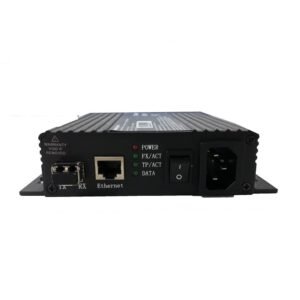
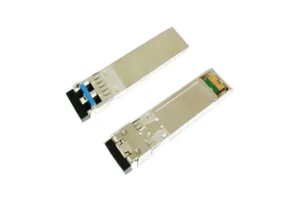
Sixteen empty cages would leave you sixteen more parts to source before anything runs. NovaStar fits the optical modules at the factory across all sixteen connectors, and they are hot pluggable. What lands on your loading dock is a chassis ready to patch, with fiber and Ethernet leads the only items you still have to buy.
NovaStar CVT-Rack320 specifications
You settle this on two rows: the channel count, which you weigh against the number of separate destinations you feed, and the electrical figures, which you weigh against the spare circuit capacity in your rack.
| Ethernet ports | 16 × Gigabit RJ45 on the sixteen-channel model |
|---|---|
| Optical connectors | 16 × single-mode twin-core LC, with optical modules installed at the factory and hot pluggable |
| Optical rate and wavelength | 1.25 Gb/s at 1310 nm per channel |
| Optical distance | 15 km per channel |
| Channel options | Four, eight, twelve or sixteen channels; specify the count when requesting a quote |
| Indicators | POWER, FX/ACT per optical link, TP/ACT per Ethernet link, and DATA, which flashes only when FX/ACT and TP/ACT are both lit |
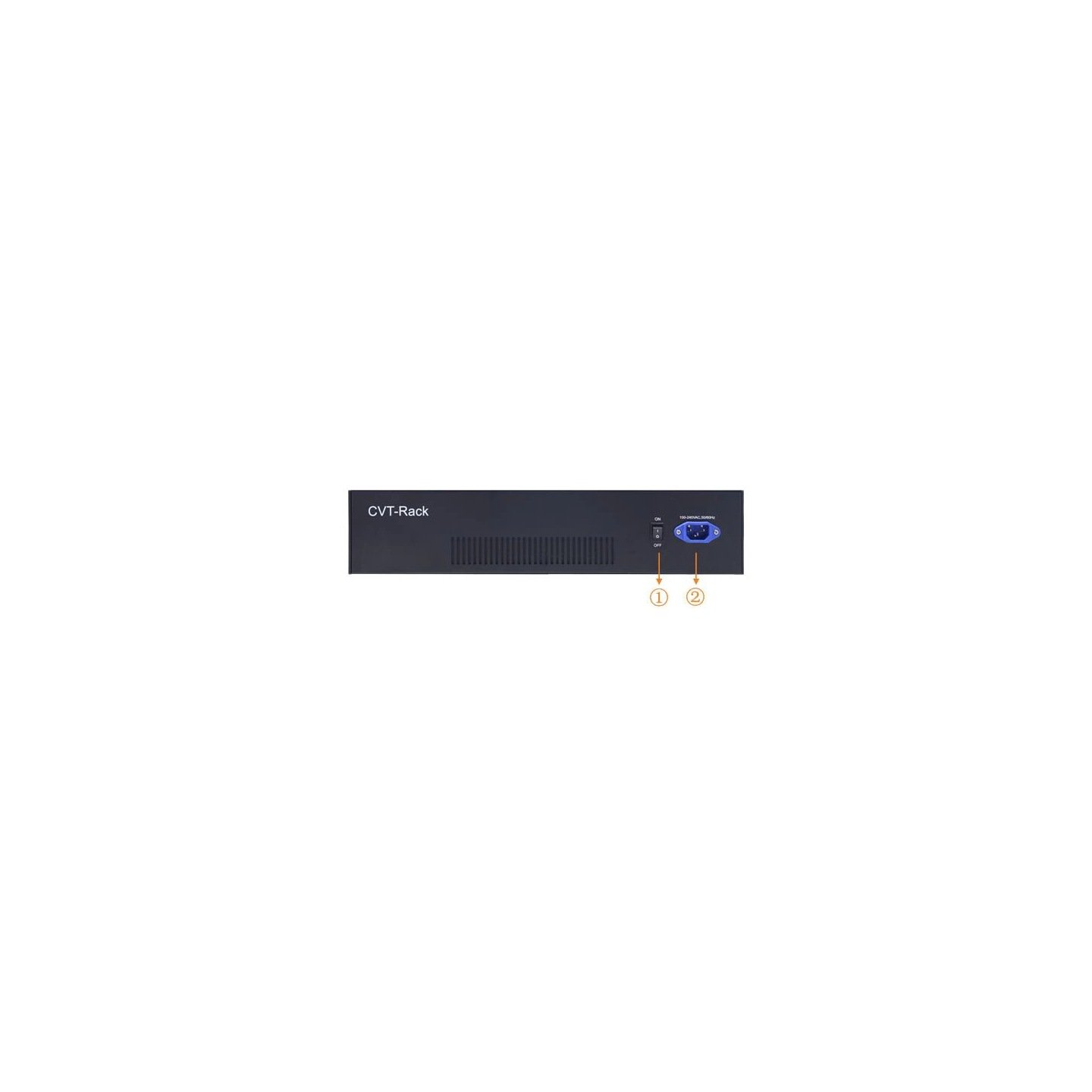
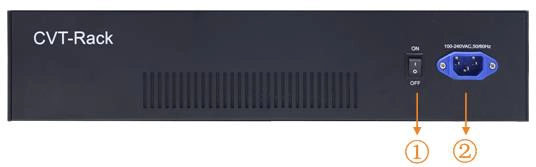
| Power input | AC 100–240 V, 50/60 Hz; rated current 0.7 A |
| Operating environment | −20°C to +70°C, 10% to 90% RH |
| Storage temperature | −30°C to +80°C |
| Dimensions and weight | 488.3 × 240.5 × 90.0 mm, 7.1 kg |
| Certifications | CE, FCC, IC |
One figure deserves your caution. NovaStar’s V1.1.0 specification lists rated power consumption at 3.5 W, the same value it gives for the single-channel CVT310, so your circuit is better sized from the 100–240 V and 0.7 A input rating than from that wattage line.
Where a CVT-Rack320 is used on an LED display system
You are feeding one head end into many destinations. In every case below your screens sit in different places rather than on one large wall, which is exactly what the independent channels are for.
What this chassis will not do for you is make one wall bigger. Point sixteen channels at a single screen and you are pulling sixteen fiber pairs to do what a trunked converter does on two.
If all sixteen of your ports feed a single wall, the CVT4K-S does it on two fibers and adds a documented backup path.
Sixteen channels or one trunk: CVT-Rack320 or CVT4K-S
You get sixteen Gigabit ports at the far end of a single-mode route from either box. What separates them is how many fibers you have to pull to get there, and what stops working when one of those fibers breaks.
| CVT-Rack320 | CVT4K-S | |
|---|---|---|
| Ethernet ports | 16 × Gigabit | 16 × Neutrik Gigabit |
| Optical connectors | 16, one per Ethernet port | 4, with OPT1 for ports 1 to 8 and OPT2 for ports 9 to 16 |
| Fiber pairs for 16 ports | 16 | 2, or 4 with the backup pair in use |
| Reach | 15 km | 10 km |
| Effect of one cut fiber | One port stops | Eight ports stop, unless the backup optical port is wired |
| Destinations served | Up to 16 separate locations | Usually one screen or one location |
| Price | Request a quote | $2,938 |
- Choose the CVT-Rack320 when the sixteen ports go to sixteen places, or when the fiber plant has strands to spare and per-screen isolation matters.
- Choose the CVT4K-S when the sixteen ports all feed one wall. Two fibers instead of sixteen is a far smaller cable order, and its OPT3 and OPT4 give the trunk a documented backup path.
- Neither is a distance upgrade for the other. The CVT-Rack320 reaches 15 km against 10 km, and that alone can decide a municipal route.
What goes at the far end of each channel?
At the far end of each channel you put another CVT-Rack320, or a matching single-mode 1G converter at each destination. NovaStar documents the chassis cascaded with a second CVT-Rack320, with the FX/ACT indicators lit at both ends confirming the optical link between them.
Rate is what rules out your other options. Each channel runs at 1.25 Gb/s, so it will not meet a 10G optical port on an MCTRL4K, a VX1000 or a CVT10-S. Where one of your destinations needs only a single port, a CVT320 at that end matches the same 1.25 Gb/s single-mode specification.
Your fiber count matters more here than your box count. Sixteen active channels want sixteen single-mode twin-core runs terminated on LC, and that line item is usually what decides whether this architecture suits your site at all.
Before you request a quote, settle three things: how many channels your job actually uses, how many separate destinations they serve, and how many single-mode strands you have available on each route.
NovaStar CVT-Rack320 manual, datasheet and specifications
Your reference document is a 2018 specification, V1.1.0, and it is still the current published one for this chassis. It carries the channel counts, the optical figures and the mechanical data your rack drawing needs. There is nothing for you to install afterwards, since this unit has no software, no firmware package and no stored configuration.
NovaStar CVT-Rack320 FAQ
How many channels does a CVT-Rack320 have?
Your CVT-Rack320 has four, eight, twelve or sixteen channels, depending on the model you order. NovaStar writes the specification around the sixteen-channel version, so name the count in your quote request.
How far does each channel reach?
Each channel reaches up to 15 km on single-mode twin-core fiber at 1310 nm. Every one of them carries the same figure, whether it is your first or your sixteenth.
Does it work with multimode fiber?
No, it does not work with multimode fiber. All sixteen connectors are single-mode, so a multimode site needs a different converter family entirely.
How many fibers does a full chassis need?
A full chassis needs sixteen twin-core fiber runs for its sixteen active channels, one per port. That cable count is usually what decides your choice between this chassis and a trunked converter.
What goes at the other end of a channel?
At the other end of a channel you put a second CVT-Rack320 where you need a matching multi-channel position, or a CVT320 where one destination needs a single port. Both run 1.25 Gb/s single-mode optics.
Can a channel connect straight to a controller fiber output?
No, a channel cannot connect straight to a controller fiber output. NovaStar controllers with optical ports publish 10G ports, and these channels run at 1.25 Gb/s, so the rates do not meet.
What does the DATA indicator mean?
The DATA indicator flashes only when FX/ACT and TP/ACT are both lit on that channel, which gives you a quick confirmation that fiber and copper are healthy before you check traffic.
How much rack space and weight does it take?
It takes 488.3 × 240.5 × 90.0 mm of rack space and weighs 7.1 kg, so it occupies a two-unit opening and your shelf or fixing has to be rated for it.
What warranty covers a CVT-Rack320?
Your CVT-Rack320 carries a warranty of three years of serial-tracked manufacturer coverage, because these units come through our authorized US NovaStar channel.
Can I get volume pricing or Net 30 terms?
Yes, volume pricing and Net 30 terms are both worth asking about. Purchase orders and Net 30 terms may be available if you are an approved school, government buyer, venue or established integrator, and a multi-chassis estate is quoted as a project.
How do I order a CVT-Rack320?
You order a CVT-Rack320 by quote, because the channel count changes the build. Send us your channel count and your destination list. Orders placed before 3 PM ET on in-stock items ship the same business day. We can confirm current availability and lead time with your quote.
Reviews
There are no reviews yet.