
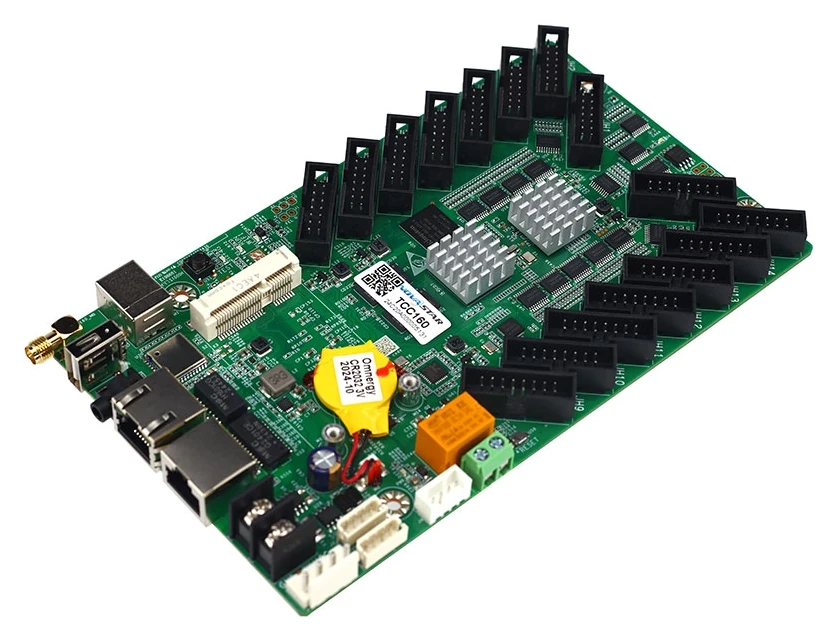
What is the NovaStar TCC160?
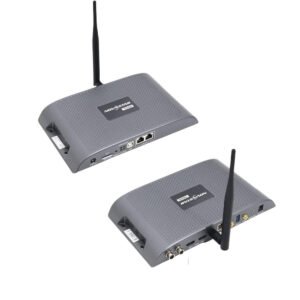
The NovaStar TCC160 is an asynchronous control card that does three jobs on one board: it stores and plays your content, it drives the screen, and it connects to your LED modules directly through sixteen HUB75E sockets. There is no player, no controller and no receiving card behind it.
That is the reason to choose one. On a small screen the usual chain is a player, a cable and another board inside each cabinet; here the ribbons from your modules land on this card and nothing else is in the path.
Buy one for storefront signs, vehicle displays, community boards and lamp-post banners — screens where the pixel count is modest, the space is tight and every extra part in the chain is a part that can fail.
NovaStar TCC160 key features
Your module ribbons plug straight in
Sixteen HUB75E sockets sit on the board, and that is the same connector your modules already use. No adapter, no ribbon order to work out between two products, and one fewer thing to buy per cabinet.
How many ribbon groups it will carry depends on how your modules are wired, and the counts are in the table below.
It works in weather that stops a player
The TCC160 is rated from −40°C to +80°C, where every boxed Taurus player stops at −20°C and +60°C. That is a genuine difference on a roadside sign in a hard winter or a sealed cabinet in summer sun.
Draw is 12 W at most, from anything between 5 V and 12 V, so it can usually share the rail already feeding your modules.
The picture controls are the ones a receiving card gives you
Because this board does that second job as well, you keep the tools that fix how a small screen actually looks: separate red, green and blue gamma, rotation in ninety-degree steps, and a wider color range covering Rec.709, DCI-P3 and Rec.2020.
Grayscale gets four times the steps, which is what stops dark content banding on a screen running at low brightness after dark.
NovaStar TCC160 specifications
Two capacity figures appear here and they answer different questions: what one card lights on its own, and what a chain of them tops out at.
| Pixels per card | 260,000, driven from its own HUB75E sockets |
|---|---|
| Pixels per chain | 650,000 across cascaded cards; maximum 2048 wide and 2048 high |
| Shape per card | 512×512 at 60 Hz on PWM driver ICs; 512×384 at 60 Hz on general driver ICs including ICN1065 and ICN1063 |
| Long thin screens | Up to 8192 pixels wide and 2048 high |
| Module connectors | 16x HUB75E; 32 parallel RGB groups, or 64 serial groups rising to 128 |
| Cascade port | 1x Gigabit, for further cards and for a multifunction card |
| Control port | 1x Fast Ethernet, plus a USB socket for a directly connected PC |
| Processor and memory | Industrial-grade quad-core at 1.4 GHz, 2 GB RAM, Android 10 |
| Internal storage | 32 GB, plus a USB 2.0 socket for drives from 2 GB to 128 GB |
| Video it can play at once | 1x 4K, or 2x 1080p, or 4x 720p, or 4x 480p, or 20x 360p |
| Sensors and switching | 2x RS485 sensor ports; 2-pin relay contact rated DC 30 V and 3 A |
| Wireless and mobile | 2.4 GHz hotspot and network together; SIM slot fitted, 4G module bought separately |
| Power in | DC 5 V to 12 V; 12 W maximum draw |
| Size and weight | 180.9 mm × 102.3 mm × 19.4 mm; 149.6 g |
| Operating range | −40°C to +80°C, 0% to 80% RH, non-condensing |
| Approvals listed | CE, FCC, RoHS, NTRA |
Figures come from NovaStar’s TCC160 Asynchronous Full-Color LED Display Control Card Specifications V1.0.8.
How many pixels one card drives, and when you need a second
One TCC160 lights 260,000 pixels through its own module sockets, which is the number to size your screen against first. The chips on your modules then set the shape: 512×512 at 60 Hz on PWM parts, or 512×384 on general parts such as the ICN1065 and ICN1063.
Ask your module supplier which of those two your panels carry before you order. It is the difference between a 512-pixel-tall screen working and coming up short by a third.
Past 260,000 you add cards rather than upgrade. Each extra card takes its own share of the modules, and the chain as a whole stops at 650,000 pixels with neither side above 2048.
A long thin screen is measured differently and may run to 8192 pixels wide. That covers a genuine ticker, where the lit total stays small even though the run is long.
What plugs into a TCC160
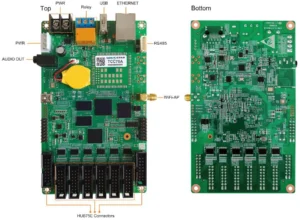
Your modules connect on the sixteen HUB75E sockets, and that is the connection this card exists to make. Everything else on the board is there to keep the screen running without a visit.
The Gigabit socket is a cascade port, not a network port: it carries the screen onward to further cards and to a multifunction card when you want scheduled power switching for the whole cabinet. Your network goes into the separate Fast Ethernet socket instead, and mixing those two up is the most common wiring mistake on this board.
Two sensor ports take a light sensor such as the NS060-5A, or a temperature and humidity sensor, so your screen dims itself instead of holding one brightness through the day. Both use the RS485 wiring your installer will already know.
A two-pin relay contact will switch a circuit you provide, up to 30 V DC at 3 A, with no voltage of its own. It is a control signal rather than a power switch: 3 A at 12 V is 36 watts, and your screen draws far more, so the device that actually carries the load sits downstream of this contact.
A TCC160, or a player and receiving cards?
A TCC160 folds the player, the screen driving and the receiving card into one board, while the other route keeps them as separate parts. Count the parts in each before you compare the prices.
| Route | One TCC160 · A player plus receiving cards |
|---|---|
| Parts in the chain | 1 · 2 or more, plus a cable to each cabinet |
| Pixels available | 260,000 per card, 650,000 cascaded · 650,000 to 2,300,000 depending on player |
| Module connection | direct on HUB75E · through a receiving card in each cabinet |
| Working temperature | −40°C to +80°C · −20°C to +60°C on the player |
| Live video input | none · available on several players |
| Price of the control part | $129 · $175 and up, before receiving cards |
Order the TCC160 when your screen is under 260,000 pixels, plays prepared content, and sits somewhere hot, cold or too shallow for a boxed player.
Order a player instead when the screen is larger, when a live source has to reach it, or when the cabinets are already built around receiving cards. The TB10 Plus is the entry point there, and the TB30 once you pass 650,000 pixels.
TCC160 datasheet, ViPlex and firmware
Configure your screen with ViPlex Express on a Windows PC, or from a phone with ViPlex Handy over the card’s own hotspot. Because this one card covers the whole chain, your module wiring and scan settings are set here rather than on a separate board.
Save both the module configuration and the playlist project after commissioning. Replacing a card without them means working out the module wiring again from scratch, and on a sign already sealed up that is the expensive part.
NovaStar TCC160 FAQ
Do I still need receiving cards with a TCC160?
No. Your modules connect to its sixteen HUB75E sockets directly, so the board that would normally sit inside each cabinet is not part of the design.
How many pixels will one card drive?
260,000 from its own module sockets. Cascade several cards and the whole screen tops out at 650,000, with neither side above 2048 pixels.
Why are two different pixel shapes quoted?
Because the chips on your modules decide it. PWM parts give you 512×512 at 60 Hz; general parts including the ICN1065 and ICN1063 give you 512×384. Ask your module supplier which is fitted before you size the screen.
Can a TCC160 take a live HDMI source?
No. It plays stored content only. A screen that needs a live input wants a player such as the TB20 Plus or the TB50 instead.
Which socket does my network go into?
The Fast Ethernet one. The Gigabit socket is a cascade port for further cards and for a multifunction card, not a network connection, and swapping the two is the usual wiring mistake here.
Will it work outdoors in winter?
Yes, inside a housing. The card itself is rated from −40°C to +80°C, which is wider than any boxed player in this range, but it still needs an enclosure to keep water off it.
Can I connect a light sensor?
Yes. Two RS485 ports take a light sensor or a temperature and humidity sensor, so the screen follows the ambient level instead of holding one setting all day.
What can the relay switch?
A circuit you provide, up to 30 V DC at 3 A, supplying no voltage of its own. Treat it as a control signal: the device that carries your screen’s own supply sits downstream of it.
What warranty covers a TCC160?
Three years of serial-tracked manufacturer coverage, because these cards come through our authorized US NovaStar channel.
Can I get volume pricing or Net 30 terms?
Yes. Send the model and the count for volume pricing. Purchase orders and Net 30 terms may be available for approved schools, government buyers, venues and established integrators.
How do I order a TCC160?
Pricing here is per card. Orders placed before 3 PM ET on in-stock items ship the same business day from Florida. Contact us to confirm current availability.
Reviews
There are no reviews yet.