
What is NovaStar H_STD I/O card?
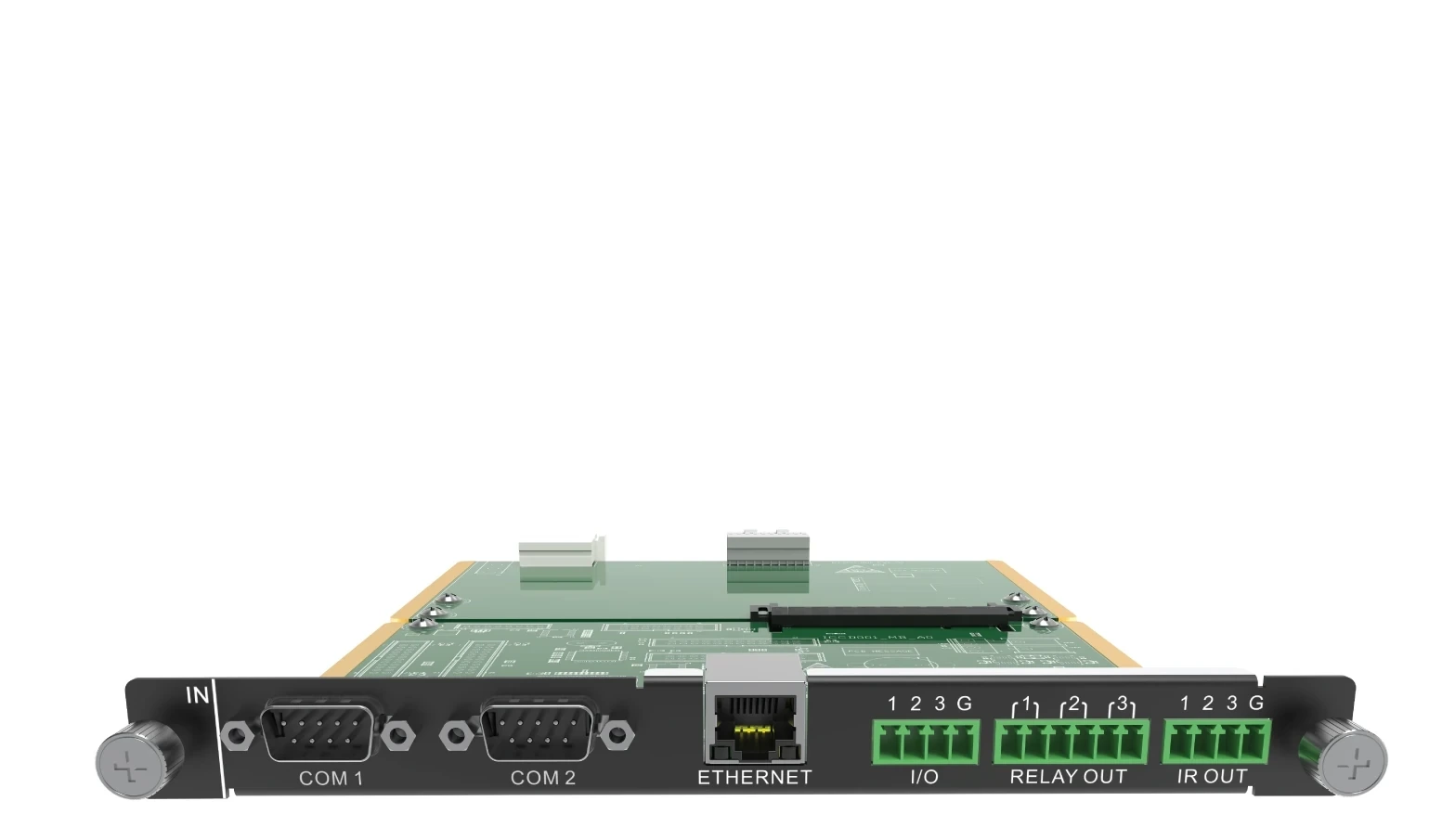
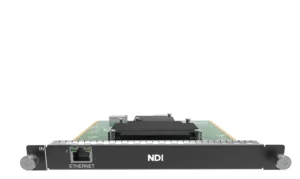
The NovaStar H_STD I/O Card is a control-interface card for a compatible H Series chassis that needs to communicate with defined external equipment. It installs in an input-card slot, but it brings in no HDMI, SDI, DisplayPort or IP video and sends no data to LED cabinets. Instead, it makes serial, Ethernet, I/O, relay and infrared connections available for a programmed system integration.
It earns that input-card slot when the LED wall must work alongside other room or venue equipment: a serially controlled endpoint, a planned contact trigger, a low-voltage relay circuit or equipment that accepts infrared commands. Before ordering, name the endpoint and intended action for every connection. The card supplies the interface hardware; the external command protocol, wiring and test remain part of the finished integration.
Request H_STD I/O Card bulk pricing →
For confirmed multi-card or project quantities. Direct checkout remains available when the chassis slot and the required external interfaces are already specified.
NovaStar H_STD I/O card key features: what it adds to an H Series system
- Keep a defined serial endpoint in the same installation: two programmable COM ports support RS422, RS485 and RS232. Choose them when the connected equipment already has a documented serial-control method.
- Use Ethernet for the control endpoint, not for LED cabinets: the 10/100 Mbps port supports TCP/IP and UDP/IP for the device attached to this card. It is not an LED cabinet-data output.
- Give each contact a clear purpose: each of the three I/O pins can be set as an input or output. Label the wiring and intended response before the card is installed, rather than treating the pins as generic spare connections.
- Plan relay and infrared endpoints at the same time as the wiring: three relay groups and three programmable IR outputs can serve suitable external equipment. Relay output is limited to 30 V DC / 3 A, so it is not a direct mains switching path.
- Spend the input-card slot on integration, not more video: the card is compact and low power, but that slot can no longer accept another video source. Buy H_STD I/O for a confirmed external-control need, not simply because an empty position is available.
NovaStar H_STD I/O card specifications
These are card-level interfaces and limits. The H Series chassis, the external device, the programming and the electrical design determine what the finished system can safely do.
How NovaStar H_STD I/O card fits an H Series control connection
The H Series input cards, video/LED output cards and H_STD I/O card have separate roles. Input and output cards handle pictures. H_STD I/O provides the programmed control connection between the chassis and a selected external endpoint, without adding a video source or cabinet route.
- Define the outside device first. Identify whether it expects serial, network, contact, relay or IR control, and keep its own protocol documentation with the design.
- Reserve an input-card slot for H_STD I/O. That slot is now for system integration, not for a new video source.
- Wire and program the intended relationship. Map every connector to one named endpoint and planned action; verify the electrical limit before energizing a relay circuit.
- Test the complete operating sequence. Confirm the external device responds as expected after normal operation and restart, before depending on it in a live room or show environment.
NovaStar H_STD I/O card connections explained
Connector names alone do not define a finished system. This table separates the card’s verified interface from the project-specific question that must be answered before purchase.
When H_STD I/O card is the right use of an input-card slot
Choose H_STD I/O Card when a compatible H Series chassis needs a real, documented external-control connection and the system design calls for serial control, Ethernet control, programmable triggers, a low-voltage relay route or IR output.
Choose a source card instead when the immediate need is another picture on the LED layout. For instance, the H_1x HDMI2.0 Input Card adds an HDMI source; H_STD I/O adds none. Use the H Series category to review chassis, source cards and LED output cards as separate decisions.
NovaStar H_STD I/O card applications
These are installation situations where the card can give a planned external connection a place in the H Series system. They do not promise a prebuilt driver or automation program for the outside equipment.
A control room where the LED wall joins the room sequence
Use the card when a designed control system needs the H Series installation to exchange commands with nearby equipment. The important decision is the external device’s documented control method, not the name of the connector alone.
A planned contact-trigger event
A door contact, console button or other low-voltage signal can have a defined role through the programmable I/O. Label each signal and test its action before the room is handed over.
A rack with serial-controlled equipment
Choose the COM ports when the surrounding equipment is already controlled by RS422, RS485 or RS232. This avoids adding an unnecessary signal conversion path simply to reach a known serial endpoint.
A display environment with a separate low-voltage relay circuit
The three relay groups can take part in a programmed equipment sequence when the electrical design stays within the card’s DC relay limit and the external circuit is approved for the installation.
NovaStar H_STD I/O card setup and safety checks
- Check the chassis and input-card position: confirm the exact installed H Series chassis has an available input-card slot for H_STD I/O. Use the H Series category to identify the chassis, then verify its own specification and slot map before reserving a position.
- Confirm the remote endpoint: match the connector type and exact command/protocol requirements to the external equipment before any wiring is finalized.
- Define I/O and relay behavior: write down which I/O pins are inputs or outputs, and keep every relay circuit within NovaStar’s 30 V DC / 3 A maximum.
- Commission the whole sequence: test each command, trigger and restart behavior with the real external equipment. Cabinet mapping and receiving-card configuration are separate LED-output tasks, not H_STD I/O setup.
NovaStar H_STD I/O card specifications, manual and firmware
The first PDF contains the official H_STD I/O Card section inside NovaStar’s current H20 specification. The manual, firmware and release notes are verified H Series family resources; their labels make the scope clear.
NovaStar H_STD I/O card specifications (PDF, H20 V1.8)
Exact H_STD I/O Card connector, programmable I/O, relay-limit, dimension and power details inside NovaStar’s H20 specification.
NovaStar H Series user manual (PDF, V1.15.0)
Verified H Series family manual for operating and configuration; it is not an H_STD I/O Card-only manual.
NovaStar H Series firmware (ZIP, V2.2.0.0)
Verified H Series family firmware package, not presented as a card-only file.
NovaStar H Series firmware release notes (TXT, V2.2.0.0)
Version changes and update notes for the same verified H Series family firmware package.
NovaStar H_STD I/O card FAQs
Is NovaStar H_STD I/O Card a video input card?
No. It installs in an input-card slot, but it does not bring HDMI, SDI, DisplayPort or IP video into the chassis. It adds external control interfaces.
Does the Ethernet port send LED data to cabinets?
No. The card’s Ethernet port is a 10/100 Mbps control connection supporting TCP/IP and UDP/IP. LED cabinet data uses the selected H Series LED output path.
Which serial protocols can the COM ports use?
NovaStar lists RS422, RS485 and RS232 for the two programmable COM ports. Confirm the external device’s control protocol and pinout before wiring.
Can the relay outputs switch building mains power?
Do not assume that. NovaStar lists a maximum of 30 V DC and 3 A for the relay output. Use a properly designed and approved external circuit for any higher-voltage equipment.
Are the three I/O pins all inputs?
No. Pins 1, 2 and 3 can each be configured as an input or output; G is their common ground. The installer must define and test every signal’s intended behavior.
Does this card replace a video source card?
Only if system integration is more important than another source from that input-card slot. Choose a video input card such as the H_1x HDMI2.0 Input Card when the immediate need is an additional HDMI source.
Which H Series chassis use H_STD I/O Card?
The H_STD I/O Card is documented in current H2, H5, H9, H15 and H20 specifications. Begin with the actual chassis, its free input-card slot and the complete system design before ordering.
Is programming included with the card?
The connectors make external control possible, but the card does not prove a prebuilt program or driver for a particular third-party device. The integration must be programmed and tested with the actual equipment.
Does H_STD I/O Card add LED cabinet paths or pixel capacity?
No. It is an external-control interface card. The cabinet path and LED pixel capacity come from the selected H Series LED output card and the chassis configuration, not from H_STD I/O.
Reviews
There are no reviews yet.