
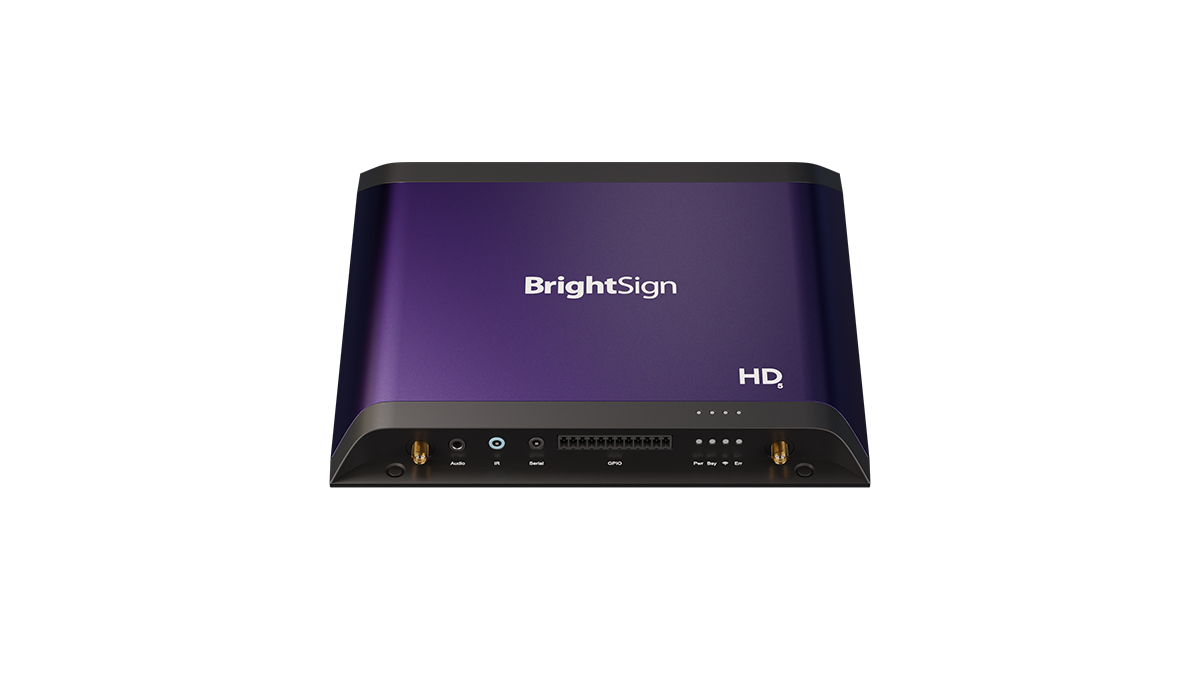
BrightSign HD225 is a digital signage player for 4K signage that needs a dependable player, wired network publishing and simple on-player triggers. Choose the HD225 when the screen needs 4K playback plus GPIO for buttons, LEDs or basic sensor triggers, but the installation does not need USB-A, serial control or PoE+.
What is BrightSign HD225?
The BrightSign HD225 is the entry HD5 player for commercial 4K signage that needs more I/O than the LS series. It gives the installation a dedicated BrightSign playback endpoint with HDMI output, gigabit Ethernet and GPIO, so a menu board, lobby display or simple interactive screen can run scheduled media without a PC left on-site.
BrightSign HD225 key features
- Single 4K HDMI playback for commercial screens, menu boards and compatible processors that need a UHD source
- Gigabit Ethernet for wired publishing, player management and more dependable network updates than Wi-Fi-only endpoints
- GPIO on the player body for buttons, LEDs, simple sensors and triggered content changes
- Local microSD playback, so the approved presentation can keep running even when the network connection is unavailable
- HD5-level BrightSign hardware for projects that need practical I/O without paying for USB, serial, PoE+ or HDMI input
Where the BrightSign HD225 makes sense
BrightSign HD225 specifications
| Series | HD5 |
|---|---|
| Product type | Digital Signage Player |
| Price | $500 |
Can the BrightSign HD225 be used with an LED wall?
Yes, but its role is specific: the BrightSign HD225 is the signage player that supplies the content signal. It stores and plays scheduled media, so a lobby screen, menu board or informational LED display does not need a computer left on-site just to keep content running.
For an LED wall, the BrightSign player’s HDMI output still needs to go into hardware that accepts and processes that signal. The NovaStar control system handles the LED-display work: a video processor or all-in-one controller accepts and scales the HDMI source, sending hardware outputs LED data, and receiving cards map that data to the LED modules. BrightSign handles the playlist, publishing method and playback reliability.
Move to the HD1025 when the player must connect to USB peripherals or serial-controlled devices. Move to XD235 or XD1035 when the signage needs PoE+, stronger WebGL motion or a more interactive experience.
BrightSign HD5 model comparison
Start with output resolution and I/O. Those two choices usually decide the right BrightSign model faster than a long feature list.
| Model | Best for | Output tier | I/O level | Choose it when |
|---|---|---|---|---|
| HD225 | Standard 4K signage | Single 4K HDMI | Standard I/O | You need GPIO and gigabit Ethernet, but not USB or serial. |
| HD1025 | Interactive 4K signage | Single 4K HDMI | Expanded I/O | You need USB-A and serial for peripherals or control. |


Reviews
There are no reviews yet.