
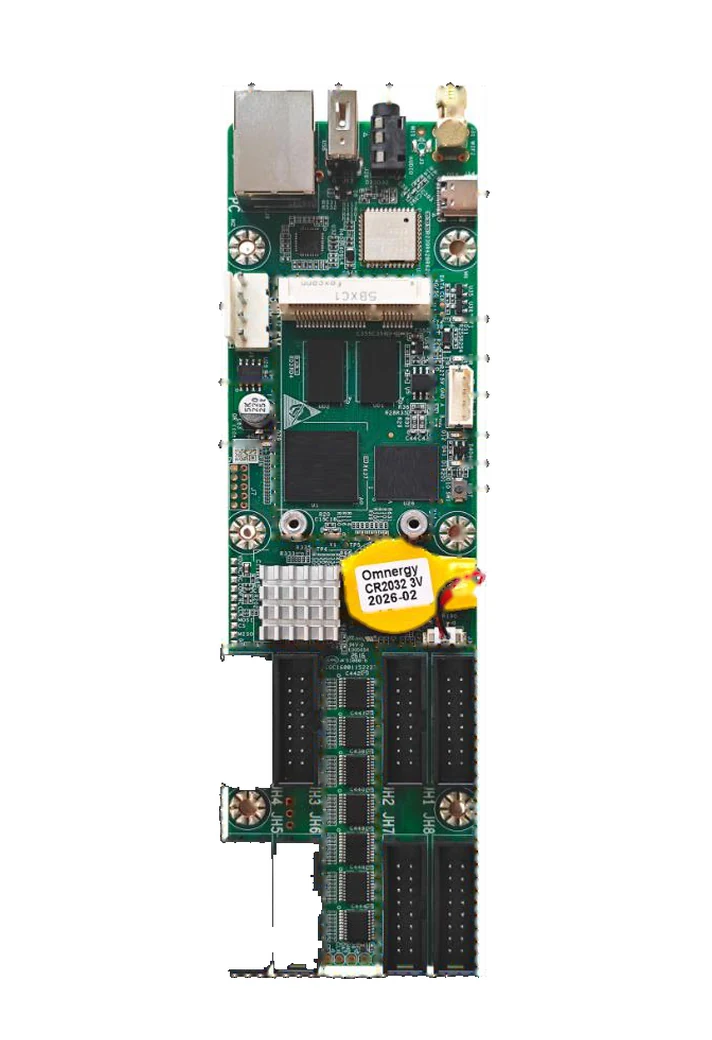
What is the NovaStar TCC80?
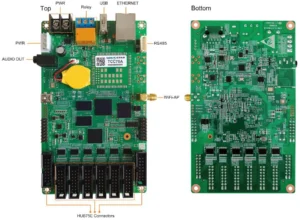
The NovaStar TCC80 is a small asynchronous control card that stores your content, plays it and drives your LED modules directly through eight HUB75E sockets. Nothing sits between it and the modules, so a complete sign needs one board rather than a player and a separate card in the cabinet.
The shape is the point. At 189.0 mm long, 51.0 mm wide and 18.4 mm thick it drops into signs that will not take anything else — shelf edges, cube displays, small traffic boards, vehicle signs and door-head panels.
NovaStar released it in April 2026 as the entry point below the TCC160, and it is deliberately narrower in every direction: fewer sockets, fewer pixels, less power and a single supply voltage.
NovaStar TCC80 key features
It fits a sign only 51 mm deep
The board is a long strip rather than a square, which is what lets it sit behind a shelf-edge display or inside a slim double-sided sign. At 83.4 g it adds almost nothing to what your fixings have to hold.
Eight HUB75E sockets run along it, so your module ribbons land in a line instead of fanning out across a wide board.
It runs on the five volts your modules already have
This card takes 4.75 V to 5.25 V and nothing else, which is a tighter window than the rest of the range and a deliberate one: every LED cabinet already carries a regulated 5 V rail for the modules themselves.
Check that your rail actually holds inside that window under load before you commit. A supply that sags to 4.6 V when the screen goes white is outside what the card accepts.
Five and a quarter watts, all in
Maximum draw is 5.25 W, which is less than half what the TCC160 takes and a fraction of any boxed player. On a solar or battery-backed sign that is the number your design lives or dies on.
It also means no heatsink to plan around and no forced airflow inside the housing.
NovaStar TCC80 specifications
Two rows carry more weight than the rest: the supply voltage, which is fixed rather than a range, and the pixel budget, which is the smallest in this range.
| Pixels per card | 160,000; 512×320 at 60 Hz and 8-bit depth |
|---|---|
| Screen shape | Maximum 2048 wide and 2048 high |
| Module connectors | 8x HUB75E; 16 parallel RGB groups, or 48 serial groups with no expansion |
| Driver ICs | Same figure for PWM and general parts, including ICN1065 and ICN1063 |
| Control ports | 1x Fast Ethernet, 1x USB 2.0 Type-C for a directly connected PC |
| Storage socket | 1x USB 2.0 Type-A, for playback, upgrade and extra storage |
| Processor and memory | Industrial-grade quad-core at 1.4 GHz, 1 GB RAM, Android 10 |
| Internal storage | 32 GB |
| Video it can play at once | 1x 1080p, or 2x 720p, or 2x 480p, or 4x 360p |
| Sensor port | 1x RS485, for a light sensor, other sensors or modules |
| Wireless and mobile | 2.4 GHz hotspot and network together; 4G module bought separately |
| Power in | 4.75 V to 5.25 V; 5.25 W maximum draw |
| Size and weight | 189.0 mm × 51.0 mm × 18.4 mm; 83.4 g |
| Operating range | −20°C to +70°C, 0% to 80% RH, non-condensing; IP20 |
| Approvals listed | None on the current datasheet |
| In the box | Card, glue stick antenna, QR card, certificate |
Figures come from NovaStar’s TCC80 Asynchronous Full-Color LED Display Control Card Specifications V1.0.0, dated 30 April 2026.
How big a screen does one TCC80 light?
One TCC80 lights 160,000 pixels, arranged up to 512 wide by 320 high at 60 Hz and 8-bit color. That shape figure holds whichever driver chips your modules carry, which is unusual and makes sizing simpler than on the larger card.
Picture what that covers. A 400×320 shelf display is 128,000 pixels and fits. A 512×256 door-head sign is 131,072 and fits. A 640×320 board is 204,800 and does not.
Video is where the smaller processor shows. This card decodes one stream at 1080p, or four at 360p, where the TCC160 manages 4K and twenty small zones. A busy multi-zone layout is the case that outgrows it before the pixel count does.
When either limit is close, the TCC160 is the same idea with sixteen module sockets, 260,000 pixels and 4K decoding.
What the TCC80 datasheet lists for approvals
NovaStar’s certifications line for this card reads “None”. That is the manufacturer’s own entry on the current V1.0.0 document, and we would rather you read it here than discover it during a submittal.
Two things follow for you. If your project is specified against a list of marks, or reviewed by an authority that asks for them, this card will not satisfy that line on its own.
And if you are building the card into a product you sell, the certification of the finished item lands with you as its manufacturer, which is the normal position for a board-level part but worth budgeting for.
Where marks are needed, the TCC160 lists CE, FCC, RoHS and NTRA, and the boxed players carry longer lists again. NovaStar notes that responsibility for selling into a market without the required approvals rests with the customer, so this is a question to settle at specification rather than at delivery.
TCC80 or TCC160 — which control card
Both cards drive your modules directly and remove the receiving card from the design. The TCC80 is smaller in every dimension that matters, and the table shows where each limit sits.
| Card | TCC80 · TCC160 |
|---|---|
| Module sockets | 8 · 16 |
| Pixels per card | 160,000 · 260,000 |
| Video decoding | 1080p · 4K |
| Memory | 1 GB · 2 GB |
| Supply | 4.75–5.25 V, 5.25 W · 5–12 V, 12 W |
| Working temperature | −20°C to +70°C · −40°C to +80°C |
| Board size | 189.0 × 51.0 mm · 180.9 × 102.3 mm |
| Approvals listed | none · CE, FCC, RoHS, NTRA |
Order the TCC80 when the sign is genuinely small, when your housing is too shallow or too narrow for a wider board, or when the power budget is measured in single-figure watts.
Order the TCC160 when the screen passes 160,000 pixels, when the content is video-heavy, when the site gets colder than −20°C, or when a certification mark has to appear on the part itself.
TCC80 datasheet, ViPlex and firmware
Set your card up with ViPlex Express on a Windows PC over the network, or from a phone with ViPlex Handy over the card’s own hotspot. Note that the direct PC connection is a USB Type-C socket here, not the Type-B used elsewhere in this range, so check what is in your bag before the site visit.
Save the module configuration as well as the playlist once the sign is working. This card holds the module wiring itself, so a replacement without that file means starting the scan setup again.
NovaStar TCC80 FAQ
Do I need a receiving card with a TCC80?
No. Your module ribbons plug into its eight HUB75E sockets directly, so the board that would sit inside each cabinet is not part of the design.
Is the TCC80 certified?
No. NovaStar’s certifications entry on the current datasheet reads “None”. If your project requires a mark on the part itself, the TCC160 lists CE, FCC, RoHS and NTRA instead.
What supply does it need?
Between 4.75 V and 5.25 V, drawing at most 5.25 W. Unlike the rest of this range it does not accept 12 V, so confirm your rail holds inside that window when the screen goes white.
How many pixels will it drive?
160,000, up to 512 wide by 320 high at 60 Hz and 8-bit color. The figure is the same whether your modules use PWM or general driver chips.
Can it play 4K video?
No. It decodes one 1080p stream, or up to four at 360p. Choose the TCC160 if the content is video-heavy or the layout has many moving zones.
How do I connect a PC to it directly?
With a USB Type-C cable. That differs from the Type-B socket used on the players and on the TCC160, so carry the right lead to site.
Can it take a live HDMI source?
No. It plays stored content only. A live input needs a player such as the TB20 Plus or the TB50.
Will it work outdoors?
Inside a housing, yes. The card is rated from −20°C to +70°C and IP20, so your enclosure keeps the water off it and the air around it inside that band.
What warranty covers a TCC80?
Three years of serial-tracked manufacturer coverage, because these cards come through our authorized US NovaStar channel.
Can I get volume pricing or Net 30 terms?
Yes. Send the model and the count and we will quote. Purchase orders and Net 30 terms may be available for approved schools, government buyers, venues and established integrators.
How do I order a TCC80?
This card is quoted per project rather than listed at a fixed price. Send the quantity and the screen resolution so we can confirm the card suits it. We ship from Florida.
Reviews
There are no reviews yet.